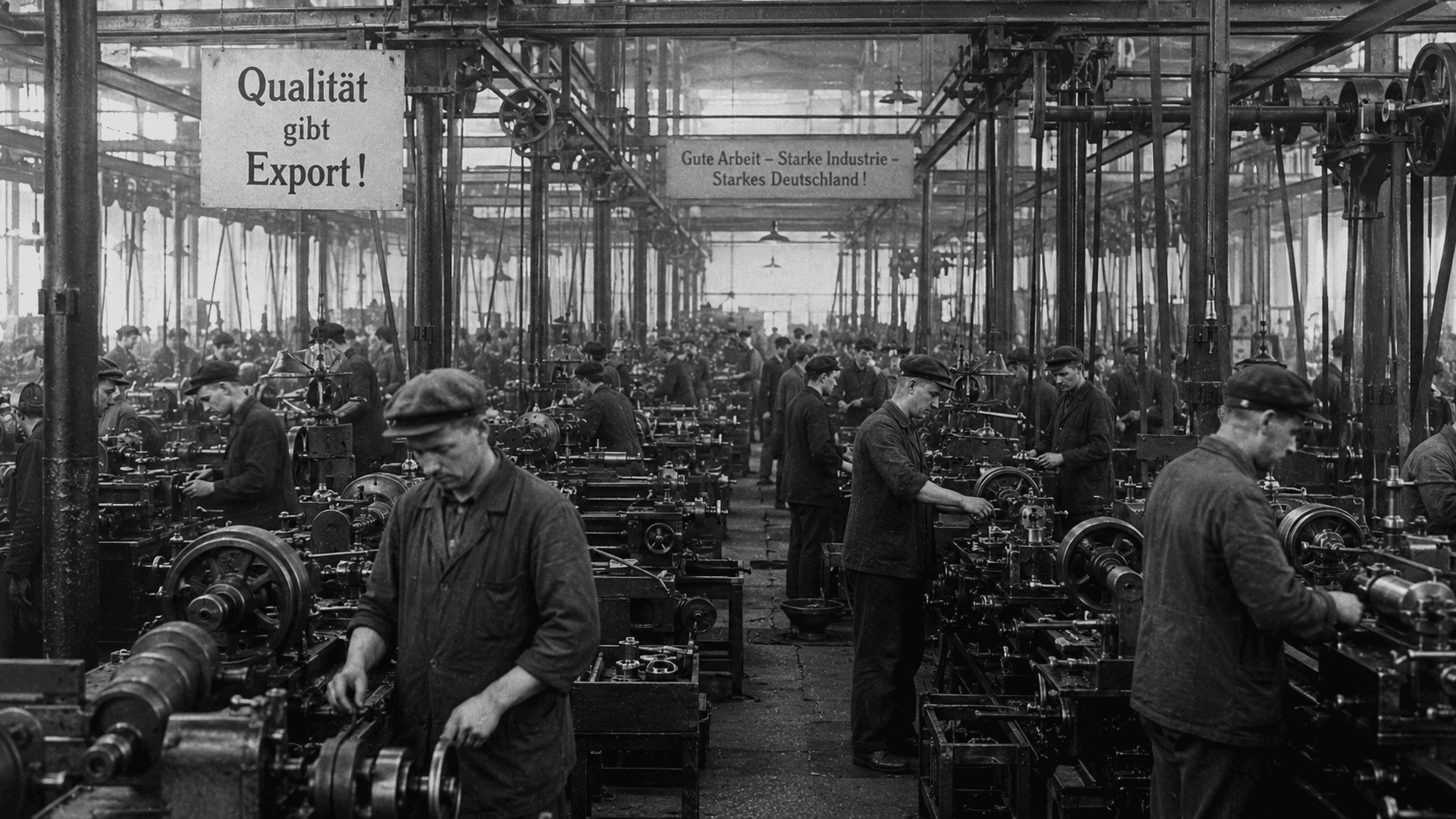
In October 1921, the Guardian ran the headline: "German Trade Boom and the Sinking Mark." The article described German industry flourishing at an unprecedented rate — profits enormous, dividends high, exports booming — while its trading partners were contracting sharply. British industrial production had fallen 31% that year. American production 22%. French production 12%. Germany had grown 45%.
The cause was not German ingenuity or superior policy. It was the collapse of the German mark. As the currency fell against sterling, the dollar, and the franc, German goods became artificially cheap for foreign buyers. German manufacturers could sell at prices their competitors simply could not match — not because they were more efficient, but because inflation had quietly subsidised every German export. The workers producing those goods were paid in marks that bought less each week. The buyers paying in hard currency got bargains. The producers — who could hold foreign currency instead of converting it into a depreciating mark — quietly became rich.
This is the first of three ways Weimar Germany shaped world trade — not through power or design, but through a monetary crisis that had unintended commercial consequences. Over twenty years, from 1919 to 1939, Germany's escalating economic catastrophes transformed European commerce in distinct and lasting ways. Understanding those transformations means understanding something important about how monetary disorder exports itself, how trade and politics interlock, and why Schacht's bilateral barter system — invented out of desperation — became a template that outlasted the regime that created it.
The Three Phases: A Quick Overview
Phase One (1919–1923): Currency depreciation inadvertently created an export boom. German goods flooded world markets at prices other nations could not match. Britain, France, and the United States experienced sharp industrial contractions while Germany boomed. This was monetary chaos, producing an accidental competitive advantage.
Phase Two (1924–1928): The Dawes Plan restored stability through American loans. Germany became Europe's largest industrial producer and absorbed 57% of net capital imports to European debtor nations. But the recovery rested entirely on short-term borrowed money — a structure waiting for a shock.
Phase Three (1928–1939): The shock came. German exports collapsed 67% between 1928 and 1932. Hjalmar Schacht responded by inventing a bilateral barter trade system that bypassed gold entirely, locking trading partners into Germany's commercial orbit by paying them in marks they could only spend buying German goods.
Phase One: The Accidental Export Empire (1919–1923)
Germany emerged from World War One with its industrial capacity largely intact. Unlike France and Belgium, where the Western Front had ground through productive agricultural and industrial land, the German homeland had not been physically fought over. Its factories were standing, its railways functional, its skilled workforce alive. What Germany lacked was stable money that the rest of the world would accept.
The Treaty of Versailles had imposed reparations that Germany could not pay in gold. The government began printing marks. As inflation accelerated, the mark fell: from 4.2 to the dollar before the war, to 64 by January 1921, to 493 by July 1922, to 17,972 by January 1923. This was not yet hyperinflation — that came in mid-1923 — but it was substantial and sustained currency depreciation.
The trade consequence was immediate. A British buyer purchasing German steel in sterling was getting more steel for every pound as the mark fell. A French buyer importing German chemicals found German prices falling week by week. German exports boomed precisely because the currency that priced them was collapsing. Industrial companies, as the Richmond Fed records, "enjoyed boom times from exports, thanks to the mark's declining value, and could buy factors of production cheaply within Germany."
The impact on trading partners
For Britain, this was severe and politically charged. British industry, which had competed with German manufacturers across global markets for decades, suddenly found itself undersold across every category — steel, chemicals, textiles, machinery. British industrial production fell 31% in 1921. Unemployment surged. The argument that Germany was conducting unfair competition through currency debasement — whether or not that debasement was deliberate — was heard loudly in Westminster and Paris.
The political economy of this was always the same: when a major economy's currency collapses, the countries competing with it in third markets suffer first. Their manufacturers lose orders. Their workers lose jobs. Their governments face pressure to retaliate with tariffs. And the country with the depreciated currency runs trade surpluses, it has no institutional mechanism to invest productively — surpluses paid for by the workers whose wages are being eroded.
The price German workers paid
The export boom was not a free lunch. German workers were paid in marks that bought less each month. An industrialist quoted in the Econlib analysis captured the transformation: "We are all actually no longer manufacturers, but have become speculators." When the hyperinflation peaked in November 1923, it ended the export boom just as suddenly as it had created it. The Rentenmark stabilised at a new parity. The accidental competitive advantage was gone overnight.
Phase Two: The Borrowed Recovery and the Golden Trap (1924–1928)
The Dawes Plan of April 1924 transformed Germany's global economic position almost overnight. By restructuring reparation payments into manageable annual instalments and opening American credit markets to German borrowing, it unlocked a flow of foreign capital that had been unavailable since before the war.
Between 1924 and 1929, more than $25 billion flowed into Germany from American investors and banks — roughly 4% of German national income annually. Germany alone absorbed 57% of net capital imports received by all 13 European debtor nations during the period. American loans helped industrial output double between 1923 and 1928. By 1929, Germany had surpassed pre-war production benchmarks by 33% and was once again Europe's premier industrial producer. Real wages for industrial workers rose 9% in 1927 and 12% in 1928, the highest in Europe.
But the structure of this recovery carried a fatal flaw that was visible to anyone who looked. The capital flowing in was predominantly short-term — it could be recalled at any moment. Germany was not earning its way to recovery through genuine export competitiveness. It was borrowing. The current account was in deficit. The growth was real, but the funding was contingent on continuous American confidence.
As the ScienceDirect academic analysis concluded, capital inflows "not only contributed to Germany's Roaring Twenties but were also instrumental in the subsequent crisis. A policy of more moderate foreign borrowing in the 1920s would have precluded a booming German economy but would also likely have prevented the country's economic bust during the early 1930s." The Golden Twenties were, in retrospect, a trap. Germany had borrowed its way into the appearance of prosperity.
Phase Three, Part One: Trade Collapse and the Road to Nazism (1928–1932)
In spring 1929, before the Wall Street crash, American speculative activity was already drawing capital back from Europe. German net capital imports peaked at RM 3.1 billion in 1928 and began declining. When Wall Street crashed in October 1929, the reversal accelerated. American banks called in loans. New lending stopped. The structure that had created the Golden Twenties collapsed.
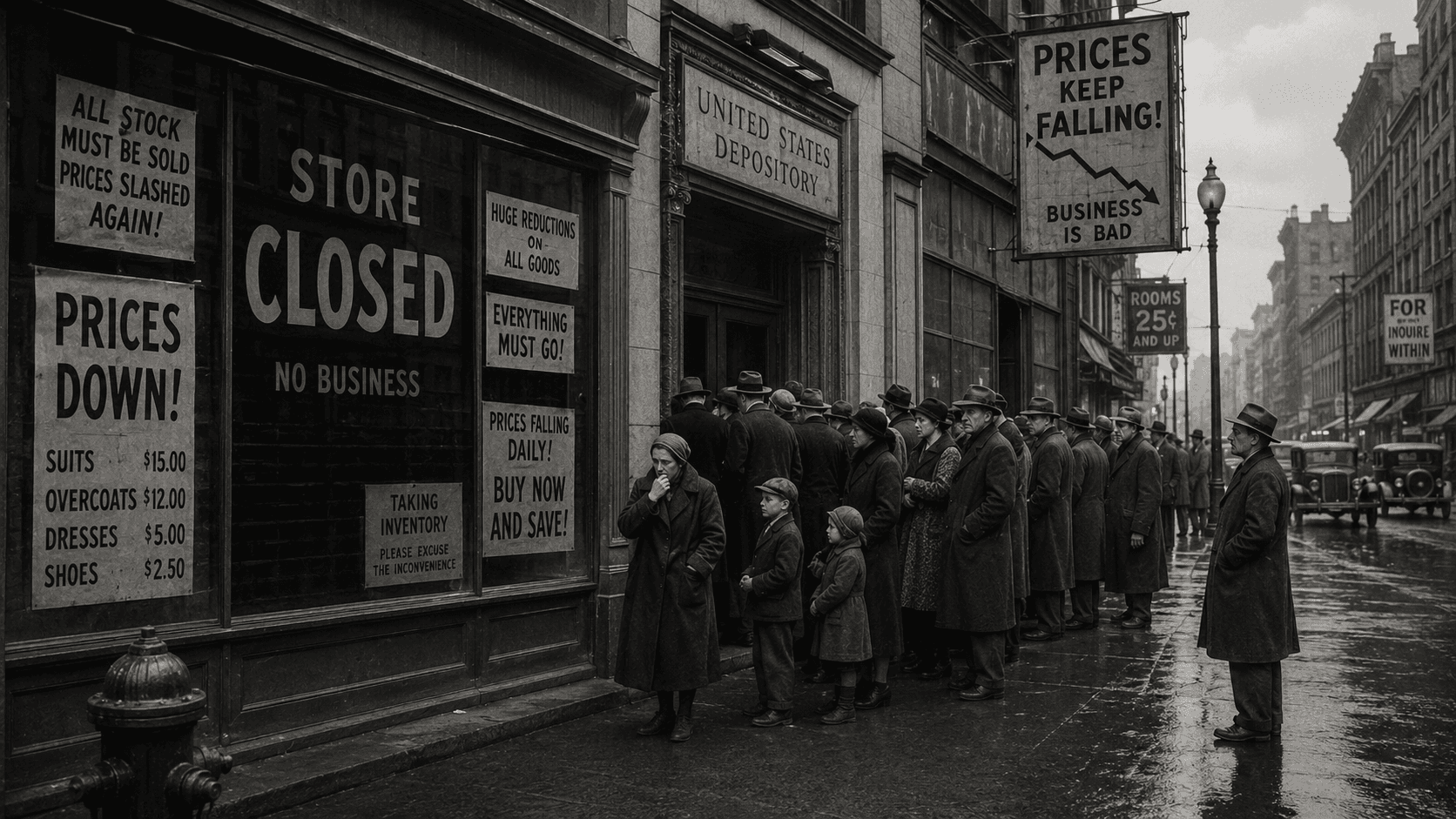
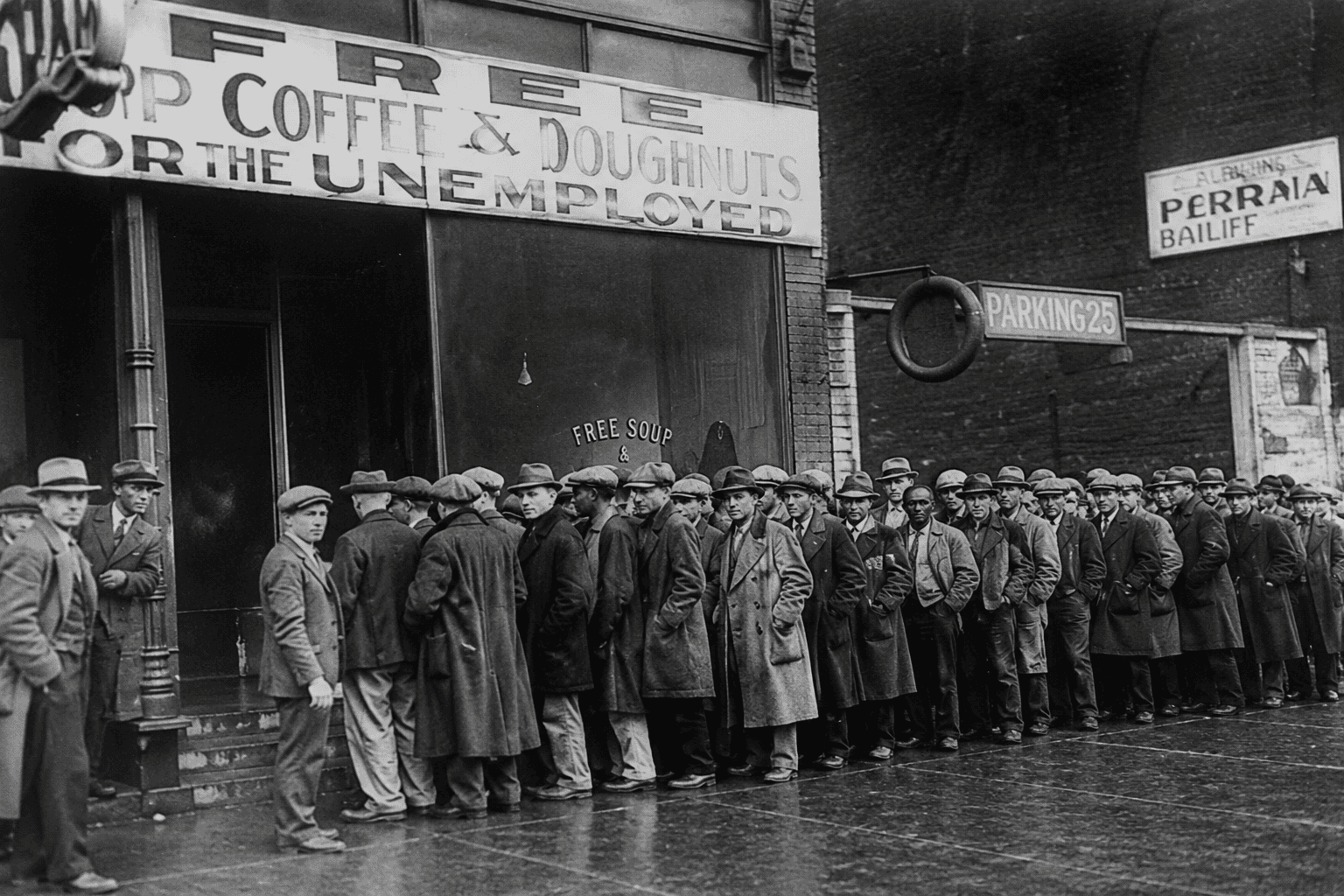
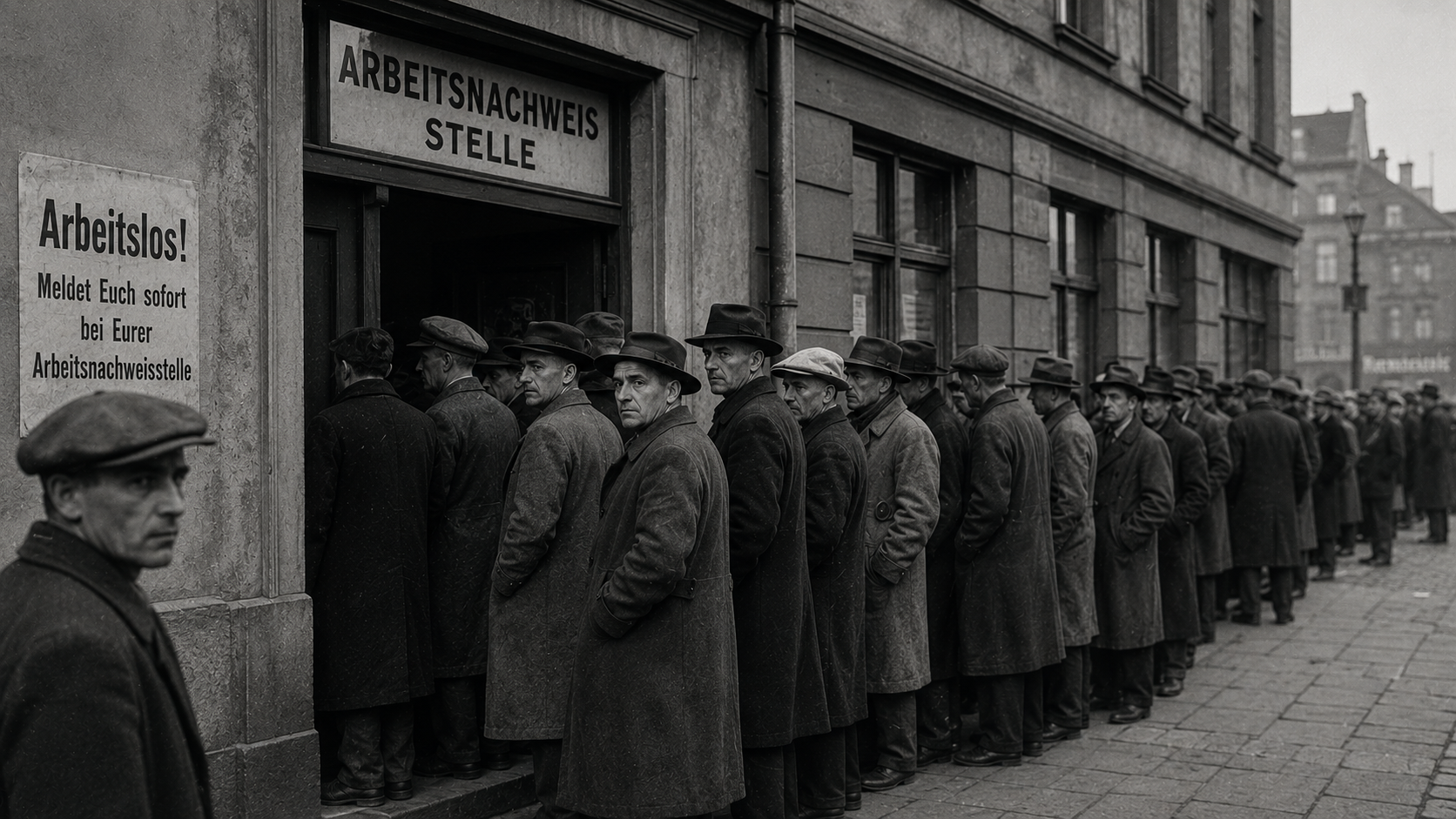
Between 1928 and 1932, German exports fell by 67%. This struck Germany with particular ferocity because the Dawes Plan recovery had been built on export-led industrial production. When export markets closed, factories shut. Unemployment, negligible in the Golden Twenties, reached 30%+ by 1932.
The political consequences were documented precisely by CITP researchers combining 1925 census employment data with German trade statistics. The 67% export collapse was equivalent to an 8% drop in GDP. But its political effects were indirect. Manufacturing areas showed a smaller increase in Nazi support. Rural agricultural areas, where food prices crashed as part of the same deflationary spiral, showed the largest Nazi swing. The Nazis' pro-agriculture policy promises — directly addressing farm income collapse — were key to their surge from 2.6% of the vote in 1928 to 37.3% in 1932.
Trade collapse, filtered through Germany's specific economic geography, had produced political catastrophe. The mechanism was: falling export demand → falling commodity prices → agricultural income collapse → rural radicalisation → democratic collapse. The destruction of world trade had destroyed the Weimar democracy.
Phase Three, Part Two: Schacht's New Plan — Inventing Managed Trade (1931–1939)
Faced with the collapse of the multilateral gold-standard trading system, Germany developed a solution that was a genuinely pioneering innovation in international commercial policy. It was designed not to restore free trade but to conduct trade without gold, without hard currency, and without dependence on any multilateral system.
The clearing agreements, 1931–1933
The first step came in 1931, when Germany began negotiating bilateral clearing agreements with Eastern European nations to manage mutual trade debts without gold transfers. Instead of paying in gold or hard currency, Germany and its trading partner would set up accounts at their respective central banks. Exports from each side would be credited; imports debited. Imbalances would be settled periodically — in goods, not gold.
These clearing agreements, extended to Western European countries in 1933, were, as ResearchGate analysis notes, "pioneering experiences in Europe that contributed to the generalisation of exchange controls and clearing offices." John Maynard Keynes later drew directly on Germany's interwar clearing architecture when designing his International Clearing Union for Bretton Woods — the precursor to the IMF's Special Drawing Rights.
The New Plan, September 1934
In September 1934, Hjalmar Schacht — serving simultaneously as Reichsbank president and Minister of Economics — introduced the New Plan. It gave the German state total control over all foreign trade and currency transactions. Every import required government approval. Foreign exchange was allocated by strategic priority: rearmament materials first, consumer goods last.
The New Plan formalised what Springer describes as "a system of bilateral trade agreements worked out on a semibarter basis; Germany purchased products from countries that would agree to purchase German products in exchange." Over 40 nations were drawn in — Southeast European and South American countries chiefly. The mechanism: trading partners were paid not in gold or dollars but in Reichsmarks held in special blocked accounts that could only be spent purchasing German goods. Payment was simultaneously a claim on future German exports. Countries received marks; Germany received raw materials and food. The marks could go nowhere except back to Germany.
Countries that needed German-manufactured goods — machinery, chemicals, steel — and had raw materials or food that Germany needed were the natural targets. Romania, Hungary, Yugoslavia, Bulgaria, and Greece became progressively integrated into Germany's commercial orbit through the Reichsmark clearing system, not through conquest but through commercial dependency built into the payment architecture.
The MEFO bill system
Alongside the New Plan, Schacht developed an equally innovative domestic financing mechanism — the MEFO bill. Contractors supplying the state received bills of exchange from a dummy company called Metallurgische Forschungsgesellschaft. These bills were state-guaranteed, circulated in the economy, and could be discounted at the Reichsbank for cash. As CEPR analysis notes, Schacht believed central banks should "make available to the economy as much money as necessary to facilitate output production" — and the MEFO bills let him expand the money supply against real output rather than government deficits. By tying each bill to specific newly produced goods, he avoided a second hyperinflation.
The combination — bilateral barter controlling trade flows externally, MEFO bills financing rearmament internally — allowed Germany to rebuild its economy and military without adequate gold reserves and without conventional international capital market access. It was a complete workaround of the global financial system.
What This Means Today
Currency depreciation is a trade policy by other means
The Weimar export boom of 1921 was unintentional, but its effect was identical to a competitive devaluation: it priced trading partners out of global markets in manufactured goods. The same mechanism is visible in modern debates about managed exchange rates, the 2010s "currency wars" between the U.S., Japan, and emerging markets, and the IMF's framework for assessing currency manipulation. A large economy's monetary disorder exports itself, and trading partners suffer the consequences whether the devaluation is intended or not.
Short-term capital flows create structural vulnerability
The Dawes Plan's injection of American capital created a recovery so dependent on external funding that its reversal produced the worst depression in European history. The same pattern recurs: Latin American debt crises of 1982, the Asian financial crisis of 1997, and Iceland in 2008. Capital that arrives quickly and leaves quickly does not build productive foundations. Weimar's Golden Twenties is the archetype of borrowed prosperity — studied by the economists who designed post-war international financial architecture precisely to prevent its recurrence.
Trade collapse translates directly into political extremism
The CITP research linking the 67% German export collapse to the Nazi electoral surge is one of the most precisely documented examples of the trade-politics connection in modern history. The mechanism was indirect — falling export demand collapsed agricultural commodity prices, rural incomes crashed, and farmers turned to the party that promised agrarian protection. This indirect transmission channel from trade shock through commodity prices to political radicalisation recurs wherever globalisation creates rapid losers with no institutional protection.
Managed trade as a geopolitical tool has deep precedent
Schacht's bilateral Reichsmark system was geopolitics by commercial means — drawing Eastern European nations into economic dependency through the structure of payment rather than military force. The same principle appears in modern debates about yuan-denominated Belt and Road loans, energy export pricing as leverage, and the IMF's analysis of dollar-denominated trade invoicing. The specific mechanisms change; the underlying logic of using trade and payment architecture to create dependency does not.
Frequently Asked Questions
How did the Weimar hyperinflation affect world trade?
Currency depreciation made German exports artificially cheap. In 1921, while British industrial production fell 31%, American fell 22%, and French fell 12%, Germany's grew 45%. This was not policy but the accidental commercial consequence of monetary collapse: a depreciating currency is equivalent in trade terms to an ongoing export subsidy, paid for by domestic workers and savers whose wages and savings lose value.
What was the Dawes Plan, and how did it change German trade?
The Dawes Plan (1924) restructured Germany's reparations into manageable payments and opened American credit markets. Between 1924 and 1929, more than $25 billion flowed in. Industrial output doubled. But the recovery rested on short-term foreign capital, not earned export competitiveness. When Wall Street crashed and American capital reversed, the structure collapsed.
How much did German exports fall during the Great Depression?
Between 1928 and 1932, German exports fell 67% — equivalent to an 8% drop in GDP. This struck Germany with particular severity because the Dawes Plan recovery had depended on export-led industrial production. The collapse fed directly into political radicalisation: the Nazi vote rose from 2.6% in 1928 to 37.3% in 1932.
What was Schacht's New Plan?
Introduced in September 1934, the New Plan gave the German state total control over all import transactions and foreign currency access. Every import required government approval. Payments with over 40 trading nations were restructured as bilateral Reichsmark barter: partners received marks they could only spend buying German goods, locking them into Germany's commercial orbit.
How did the trade collapse lead to Nazi electoral success?
CITP research shows the mechanism was indirect. The 67% export collapse drove down agricultural commodity prices, which crashed rural farm incomes. Farmers in the German hinterland — the hardest hit — turned to the Nazi party, which explicitly promised agricultural support and protectionism. Manufacturing areas with direct export exposure showed smaller Nazi swings than agricultural areas.
What legacy did Schacht's bilateral trade system leave?
Germany's clearing agreements of 1931 onwards were studied internationally. Keynes explicitly drew on European interwar clearing architecture when designing his International Clearing Union for Bretton Woods — the precursor to IMF Special Drawing Rights. Schacht's framework also influenced post-war thinking on bilateral trade agreements, capital controls, and the political economy of managed exchange rates.
What modern parallels exist to Weimar's trade dynamics?
Three patterns recur. Currency depreciation as an accidental trade weapon: visible in modern exchange rate debates and IMF currency manipulation assessments. Short-term capital inflows creating structural vulnerability: Latin America 1982, Asia 1997, Iceland 2008. Trade collapse producing political extremism through indirect commodity-price channels: documented across multiple modern economies experiencing rapid globalisation-driven disruption.