No single event destroyed the American economy between 1929 and 1933. It was a cascade — a stock market crash that exposed fragile banks, policy errors that strangled trade, and a Federal Reserve that watched the monetary system implode without intervening. The economic collapse of the Great Depression turned an ordinary recession into the most destructive economic disaster in modern history, reshaping governments, rewriting the rules of finance, and leaving scars that influenced policy for the next century.
We trace the full chain of collapse here: the causes, the escalation, the human cost, and the painful recovery. Whether you’re studying economic history or watching today’s headlines about tariffs, banking stress, and monetary policy, the Great Depression remains the single most important case study in what happens when everything that can go wrong does.
The Great Depression at a Glance: What Happened?
The Great Depression began in the United States in the summer of 1929 as what appeared to be a routine recession. The stock market crash in October of that year — culminating in Black Monday on 28 October and Black Tuesday on 29 October — destroyed investor confidence and wiped out billions in wealth. But the crash alone did not cause the Depression. What turned a downturn into a catastrophe was the collapse of the banking system. Between 1930 and 1933, roughly 9,000 of America’s 25,000 banks failed, evaporating savings and choking off the credit that businesses needed to operate.
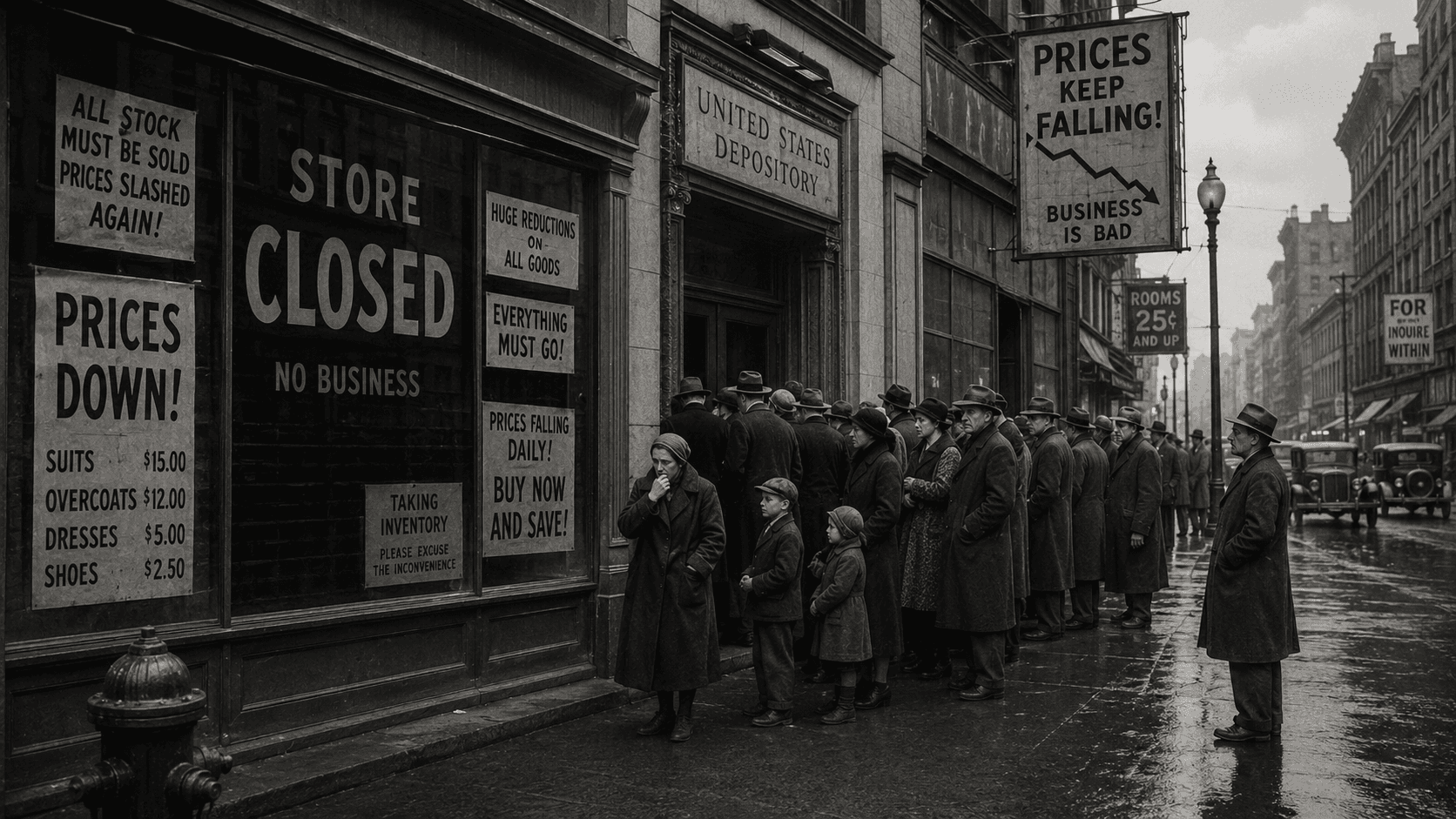
By 1933, real GDP had fallen by approximately 30%, industrial production had declined by 47%, and unemployment had reached 25% of the civilian labour force. Wholesale prices dropped by about 33%, triggering a vicious deflationary spiral. The Smoot-Hawley Tariff Act of 1930 — which raised duties on over 20,000 imported goods — invited retaliatory tariffs from more than two dozen nations, and international trade collapsed by roughly 65% between 1929 and 1934. Recovery did not truly arrive until wartime industrial mobilisation in the early 1940s.
The Roaring Twenties: Prosperity Built on Fragile Foundations
To understand the economic collapse of the Great Depression, you first have to understand the decade that preceded it. The 1920s were a period of remarkable growth. Between 1921 and 1929, real GDP grew at an average rate of nearly 5% per year. Consumer credit expanded rapidly, enabling Americans to buy cars, radios, and household appliances on instalment plans. The stock market soared, and investing came to be seen as a sure path to wealth.
But several structural weaknesses lurked beneath the surface. Agricultural incomes had been depressed throughout the decade — farmers who had expanded production during the First World War found themselves competing in oversaturated global markets with falling commodity prices. Meanwhile, wealth inequality was widening. By 1929, the richest 1% of Americans held roughly a third of the nation’s wealth, while the bottom 80% held barely 10%. This concentration meant that consumer spending power was narrower than headline economic figures suggested.
The Federal Reserve, still a relatively young institution (created in 1913), had increased the money supply by roughly 67% between 1921 and 1929. This expansion kept interest rates low, encouraged borrowing, and fuelled speculative investment — particularly in the stock market. By the late 1920s, hundreds of millions of shares were being purchased on margin, meaning investors were borrowing heavily to buy stocks and relying on future price rises to repay those loans. The foundation was set for a spectacular collapse.
The Crash: October 1929 and the Destruction of Confidence
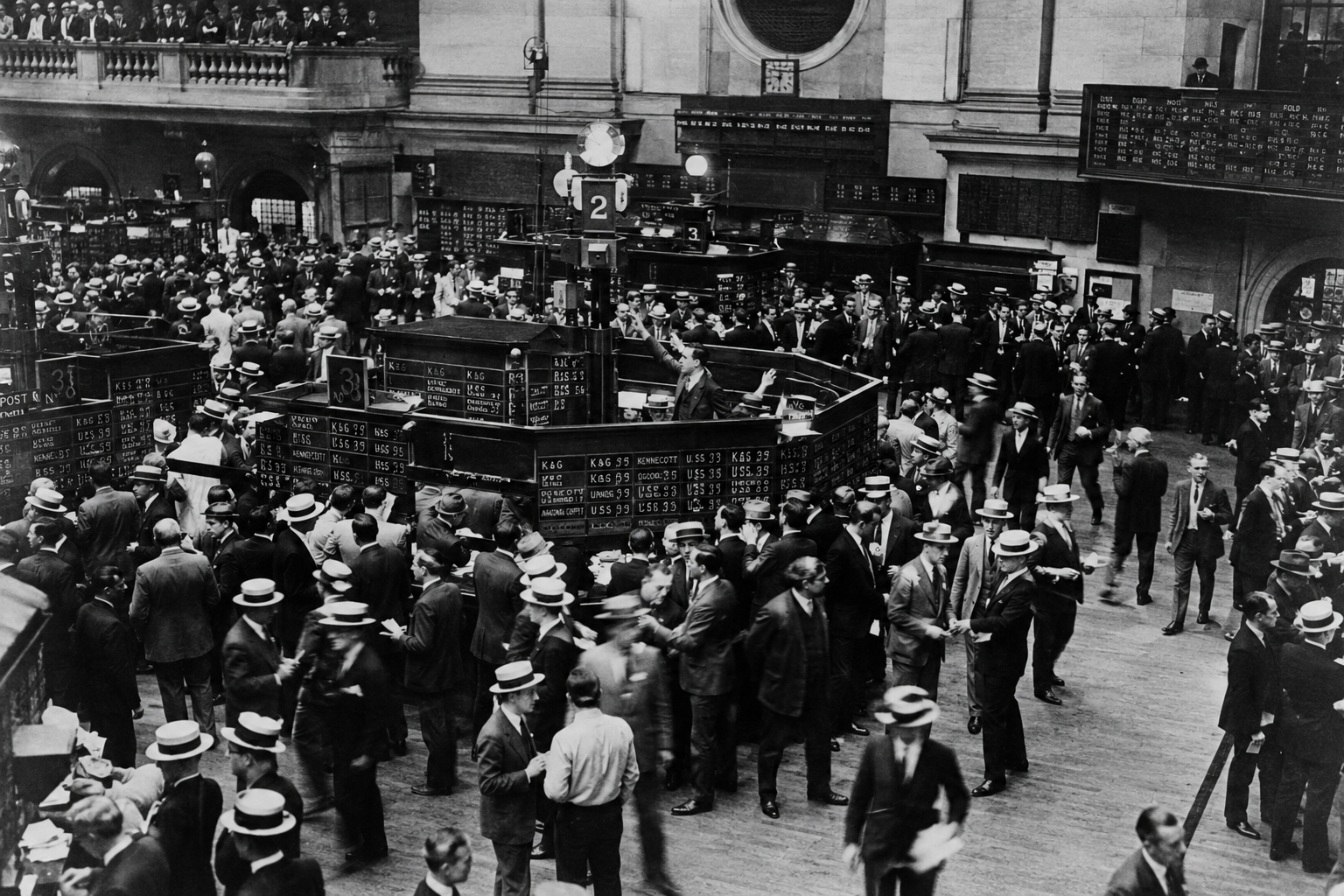
The stock market had been showing signs of overvaluation throughout the summer of 1929. When prices began declining in October, millions of over-leveraged shareholders panicked. On Black Monday, 28 October 1929, the Dow Jones Industrial Average fell nearly 13% in a single session. The following day, Black Tuesday, saw another devastating sell-off as 16 million shares changed hands in scenes of outright chaos on the trading floor.
Between September 1929 and July 1932, the stock market lost approximately 89% of its value. The wealth effect was devastating. But more importantly, the crash shattered business and consumer confidence. Spending and investment fell sharply as both individuals and firms braced for the worst.
It is worth noting, however, that only about 16% of American households were directly invested in the stock market at the time. Historians and economists continue to debate whether the crash itself was sufficient to trigger a depression of this magnitude, or whether it was the cascade of policy failures that followed — particularly the collapse of the banking system and the Federal Reserve’s inaction — that transformed a severe recession into something far worse.
The Banking Crisis: When the Financial System Collapsed
If the stock market crash was the spark, the banking crisis was the wildfire. Between 1930 and 1933, the United States experienced three major waves of banking panics. Depositors, terrified of losing their savings, rushed to withdraw funds — and since banks at the time operated on a fractional reserve basis with no federal deposit insurance, these runs quickly became self-fulfilling prophecies.
By 1933, approximately 9,000 banks had failed — more than a third of the entire system. The Federal Deposit Insurance Corporation did not yet exist; there was no safety net for depositors. When a bank went under, ordinary savers lost everything. U.S. Steel, one of the nation’s largest employers, saw its full-time workforce shrink from nearly 225,000 in 1929 to zero by 1 April 1933 — every remaining employee was working part-time.
The Federal Reserve’s failure to act as a lender of last resort during these panics is now widely regarded as its most consequential error. The money supply contracted by nearly 30% between 1930 and 1933. Milton Friedman and Anna Schwartz, in their landmark work A Monetary History of the United States, argued that this monetary contraction — not the stock market crash or trade policy alone — was what made the downturn so deep and so prolonged. In 2002, Federal Reserve Governor Ben Bernanke publicly acknowledged this, stating that the Fed’s mistakes had contributed to the worst economic disaster in American history.
Trade Wars and the Smoot-Hawley Catastrophe
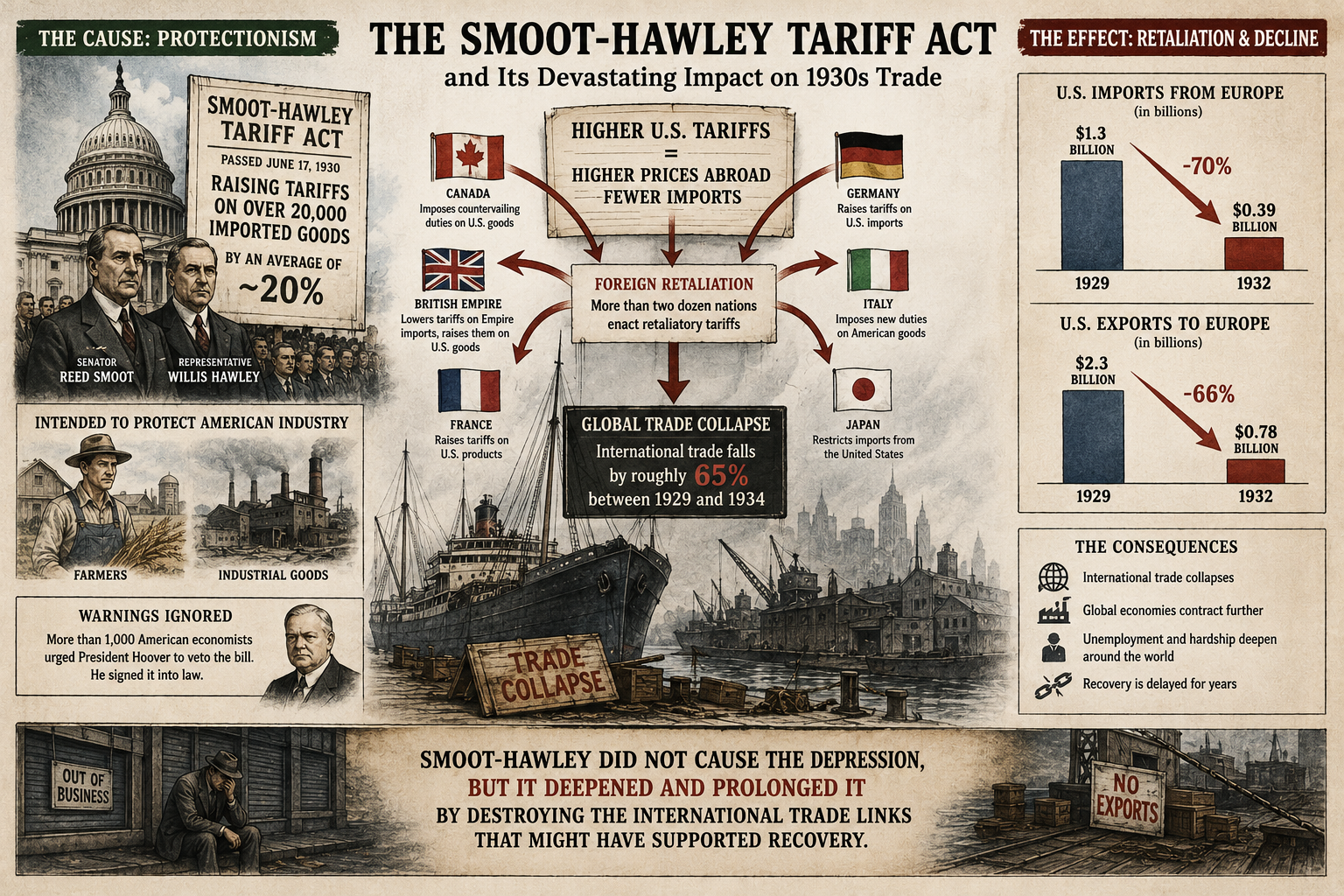
As the domestic economy contracted, Congress reached for a familiar tool: protectionism. In June 1930, President Herbert Hoover signed the Smoot-Hawley Tariff Act, which raised import duties on over 20,000 goods by an average of roughly 20%. The legislation had been intended to protect American farmers, but its scope was expanded to cover industrial goods as well.
The consequences were swift and severe. More than 1,000 American economists had signed a letter urging Hoover to veto the bill. They were ignored. Within two years, more than two dozen nations had enacted retaliatory tariffs. Canada immediately imposed countervailing duties on American goods while lowering tariffs on imports from the British Empire. International trade collapsed by roughly 65% between 1929 and 1934. U.S. imports from Europe fell from $1.3 billion in 1929 to just $390 million by 1932. American exports to Europe dropped from $2.3 billion to $784 million over the same period.
Smoot-Hawley remains one of the most studied examples of how protectionist trade policy can backfire catastrophically. It did not cause the Depression, but it deepened and prolonged it by severing the international trade links that might have supported recovery.
The Human Cost: Unemployment, Migration, and the Dust Bowl
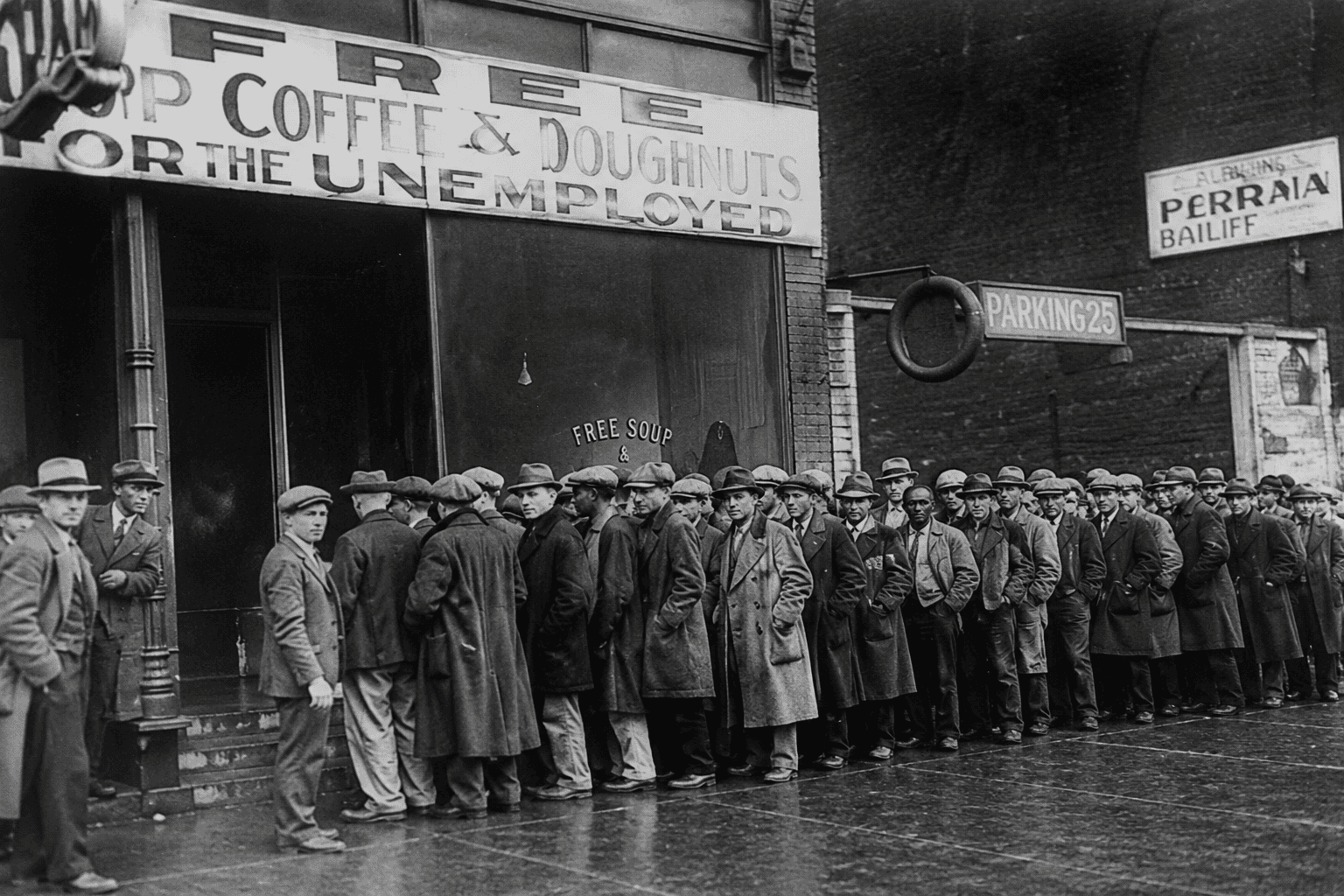
Behind the economic statistics lies an immense human catastrophe. At the Depression’s nadir in 1933, 12.8 million Americans — nearly 25% of the civilian workforce — were unemployed. In some industrial cities, the figures were far worse: unemployment reportedly reached 50% in Cleveland and an astonishing 80% in Toledo, Ohio. Wage income for those who kept their jobs fell by 42.5% between 1929 and 1933.
Families were uprooted. Shanty towns known as “Hoovervilles” sprang up across the country. Over a million families lost their farms between 1930 and 1934. The agricultural crisis was compounded by an environmental disaster. The Dust Bowl of the mid-1930s devastated the Southern Great Plains. An estimated 2.5 million people were displaced. In many regions, more than 75% of the topsoil was blown away by the end of the decade.
The Global Contagion: How the Depression Spread Worldwide
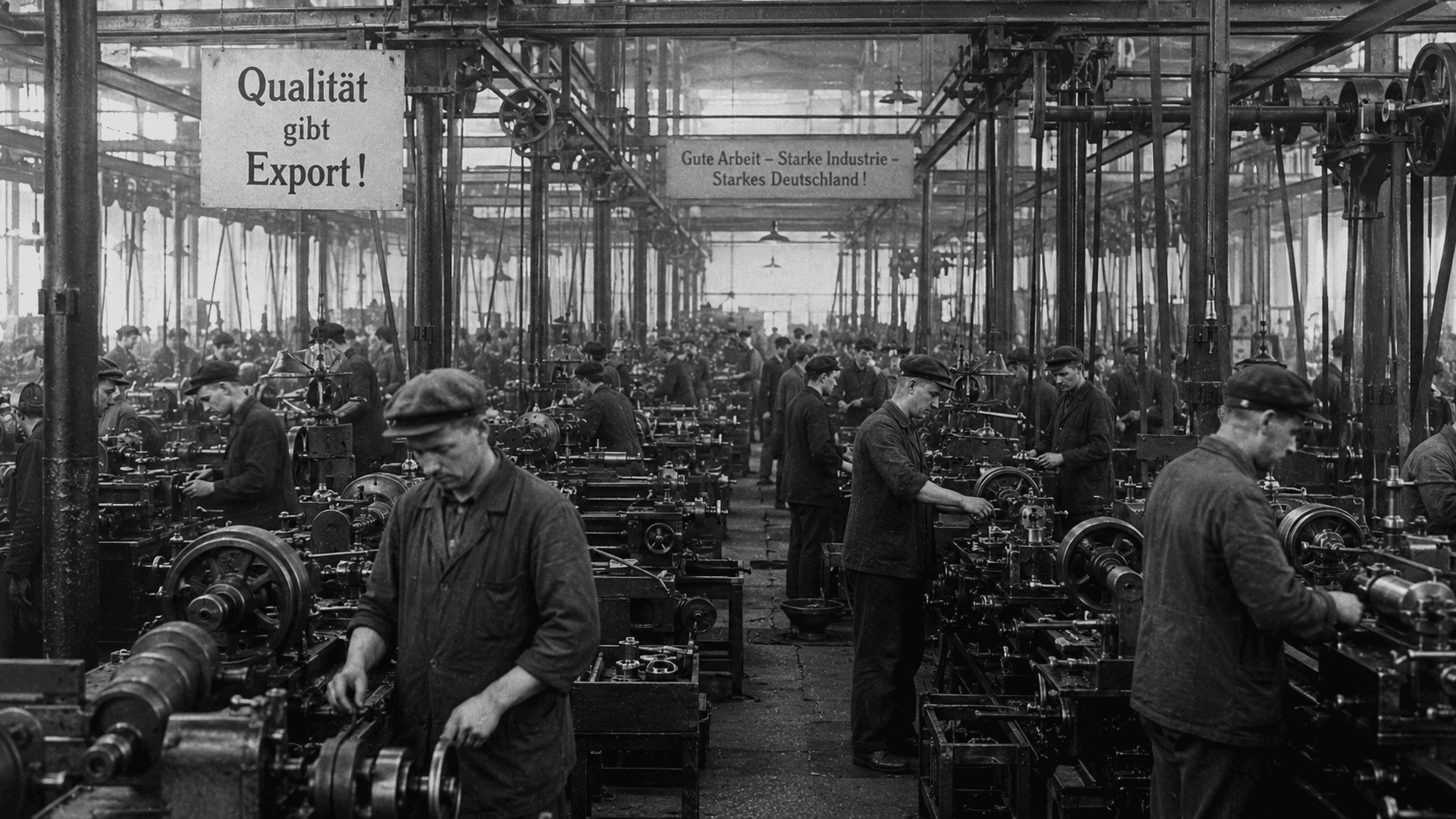
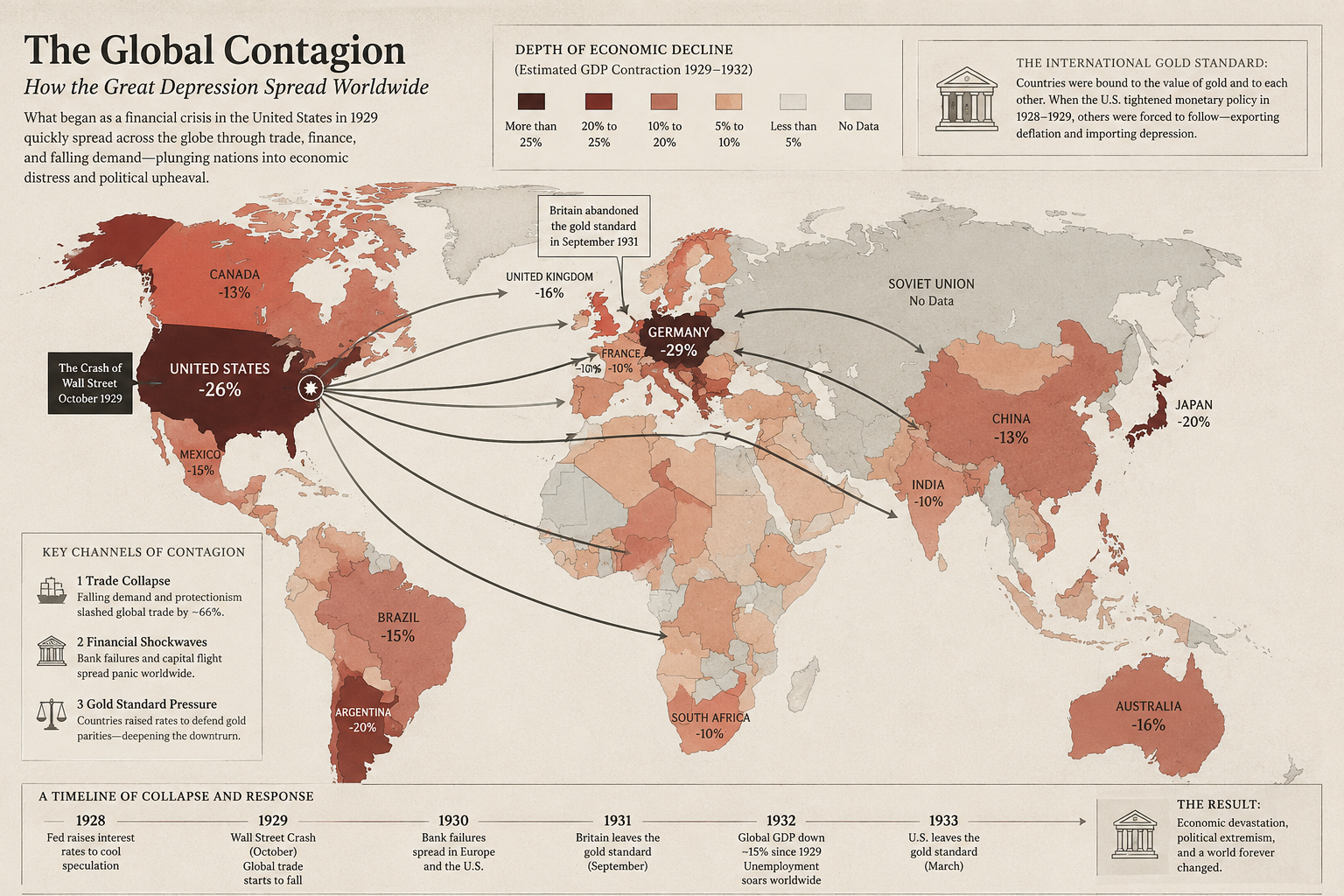
The international gold standard served as a transmission mechanism for economic distress. When the Federal Reserve raised interest rates in 1928–1929 to curb stock market speculation, foreign central banks were forced to follow suit. Between 1929 and 1932, worldwide GDP fell by an estimated 15%. Germany, heavily dependent on American loans, was particularly hard hit — unemployment reached nearly 30%, fuelling the rise of the Nazi Party. Britain abandoned the gold standard in 1931, followed by the United States in 1933.
Recovery: The New Deal and the Road Back
When Franklin D. Roosevelt took office on 4 March 1933, the banking system had effectively ceased to function. His first act was to declare a national bank holiday, suspending all banking activity for four days. Congress swiftly passed the Emergency Banking Act. In his first Fireside Chat, Roosevelt urged Americans to return their savings to the banks. By the end of the month, nearly three-quarters of the nation’s banks had reopened.
The First New Deal (1933–34) focused on immediate relief: the CCC put unemployed young men to work; the AAA sought to raise farm prices; the NRA established industry codes. The Second New Deal (1935–36) introduced structural reforms: Social Security, the Wagner Act, the SEC, and the FDIC. Before the FDIC, more than 500 banks had been failing per year. After its creation, failures dropped to fewer than ten per year.
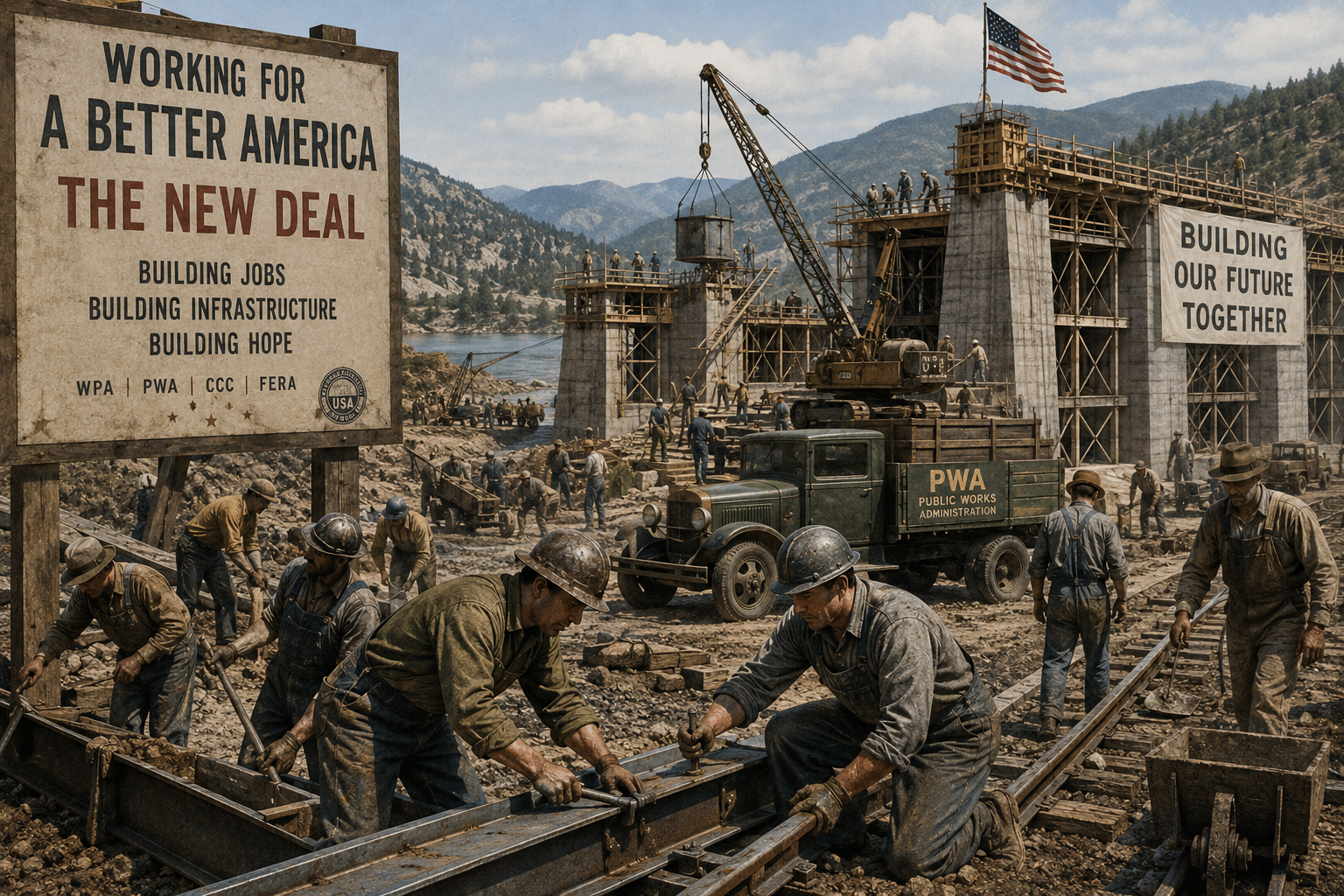
Despite these interventions, unemployment remained stubbornly high. By 1935, roughly 20% of the workforce was still jobless. Most scholars conclude that full recovery came only with wartime industrial mobilisation, which drove unemployment below 2% by 1942.
What This Means Today: The Great Depression’s Modern Legacy
The Great Depression is not merely a historical curiosity. It is the foundational case study that shaped modern economic policy, and its lessons remain urgently relevant.
Central Banks Learned — Eventually
The Fed’s failure to act during the 1930s directly informed the response to 2008. When Lehman Brothers collapsed, Ben Bernanke — a Depression scholar — deployed aggressive monetary expansion. The result: a severe recession, but not a second Great Depression.
Trade Wars Still Carry the Same Risks
Smoot-Hawley demonstrated that protectionism during a downturn amplifies the damage. Trade accounted for 16% of global output in the 1930s; today it is around 60%. Modern tariff disputes carry proportionally greater risk.
Deposit Insurance Changed Everything
The FDIC is arguably the single most successful financial reform of the twentieth century. Bank runs effectively ceased after its creation. The principle is now accepted worldwide.
The Social Safety Net Was Built on Depression-Era Wreckage
Social Security, unemployment insurance, minimum wage laws, securities regulation, and collective bargaining rights — all emerged from the New Deal. They were direct responses to a catastrophe that exposed the human cost of an economic system with no floor beneath it.
Frequently Asked Questions
What caused the economic collapse of the Great Depression?
The Depression was caused by a combination of factors: the 1929 stock market crash, cascading bank failures (1930–33), the Fed’s failure to expand the money supply, the Smoot-Hawley Tariff, which collapsed trade, and structural weaknesses including agricultural distress, wealth inequality, and excessive margin lending.
How much did GDP fall during the Great Depression?
Real GDP declined by approximately 29–30% between 1929 and 1933. Industrial production fell roughly 47%. Globally, GDP fell an estimated 15% between 1929 and 1932.
How many banks failed during the Great Depression?
Approximately 9,000 banks failed between 1930 and 1933 — more than a third of the entire U.S. banking system. There was no deposit insurance, so depositors lost everything.
What was the Smoot-Hawley Tariff, and why did it matter?
The 1930 Act raised duties on 20,000+ goods. Over two dozen countries retaliated, and international trade collapsed by ~65% between 1929 and 1934. It deepened the crisis by severing trade links.
What was unemployment during the Great Depression?
Unemployment rose from ~3% in 1929 to ~25% by 1933. In some cities, it was far worse. Full employment only returned with wartime mobilisation in the early 1940s.
Did the New Deal end the Great Depression?
Most scholars conclude that the New Deal alleviated the worst effects but did not end it. Full recovery came with wartime industrial mobilisation for WWII.
How does the Great Depression compare to the 2008 crisis?
The 2008 crisis saw GDP fall by~4.3% and unemployment peak near 10%. In the Depression, GDP fell 30%, and unemployment hit 25%. The key difference was the policy response — in 2008, policymakers acted aggressively, having learned from the 1930s.