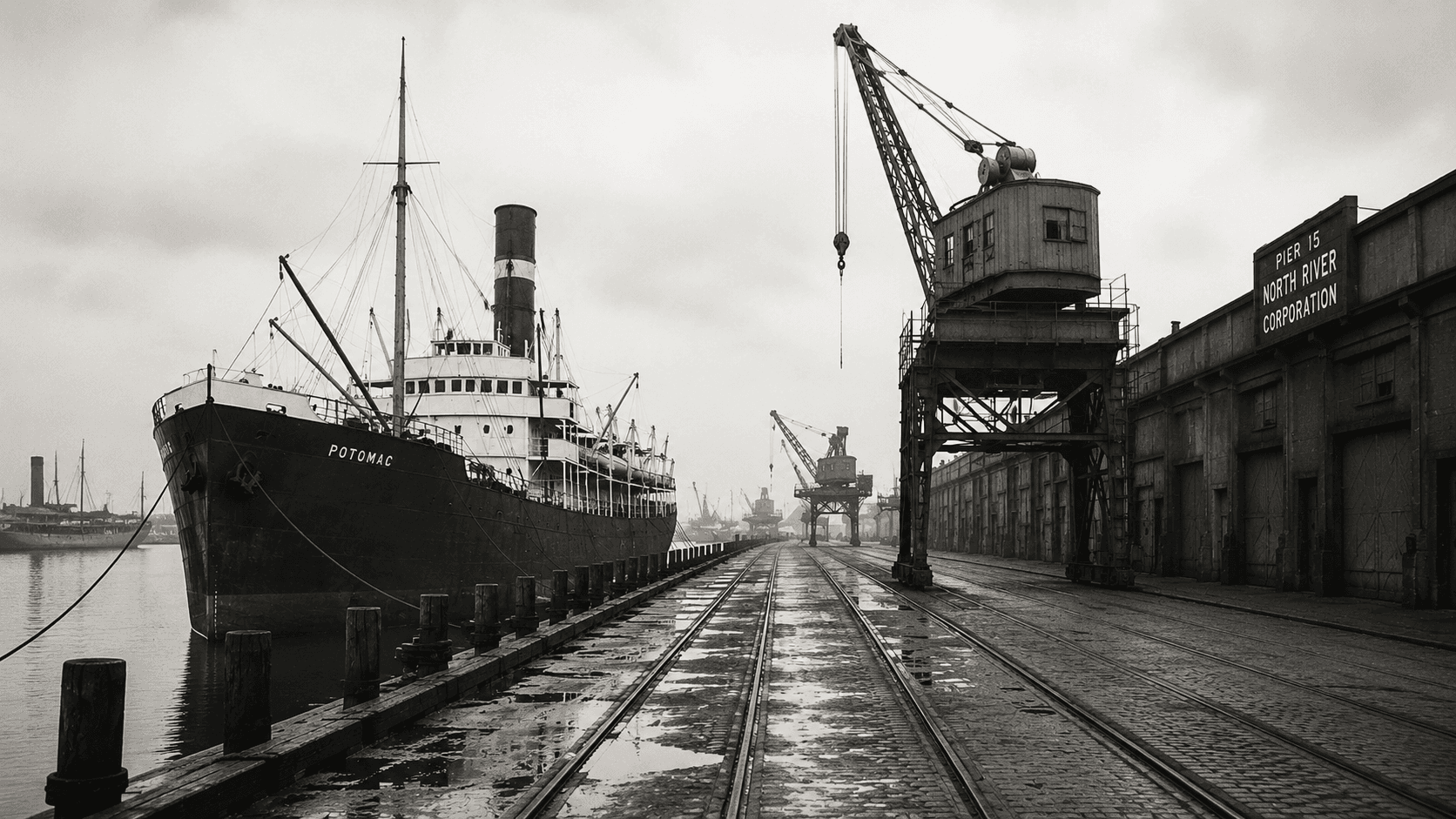
Between 1929 and 1933, the value of world trade fell by roughly two-thirds. In dollar terms, American exports collapsed from $5.2 billion to $1.7 billion — a drop of 67%. British exports fell 49%. French exports fell 50%. Global commerce, which had already become the engine of post-war recovery, ground to a near halt. When this happened, every nation that depended on exporting goods — every farmer in Argentina, every mill worker in Britain, every merchant in Japan — lost the markets on which they depended. The Great Depression did not just reduce trade. It controlled and reshaped how trade worked, fragmenting a global system into competing regional blocs and setting patterns that would last for decades.
This is the story of that collapse: how it happened, why rational policies made things worse, and what it teaches us about the fragility of international commerce.
The Numbers: A Global Commerce Apocalypse
The scale of trade collapse is difficult to overstate. Between 1929 and 1933, the value of world trade fell by roughly two-thirds, according to contemporary records and historical analysis. In the United States specifically, American exports declined from about $5.2 billion in 1929 to $1.7 billion in 1933, and not only did the physical volume of exports fall, but the prices fell by about 1/3 as well.
This was not a proportional decline following a proportional fall in output. While global GDP fell by approximately 15% between 1929 and 1932, trade fell by 60–67%. Trade had become *more* fragile than the underlying economy — a warning signal about how much the world had come to depend on open, functioning markets.
The decline was not uniform across all regions, but was particularly devastating in nations that had built their post-war recovery on export-led growth.
The Collapse of Commodity Markets
If manufactured trade was hammered, commodity markets were destroyed utterly. Wheat prices fell by 40 per cent and rice by 50 per cent globally. The price of coffee, cotton, rubber, and other cash crops fell 40 per cent, crippling the economies that produced them.
For nations like Argentina (wheat), Brazil (coffee), India (cotton), and Malaya (rubber), this was catastrophic. These were not luxury exports that could be reduced during hard times. They were the only foreign currency source for entire economies. When wheat fell from $1.29 per bushel in 1929 to $0.77 by 1933, Argentine farmers could no longer afford to import the manufactured goods they depended on. The collapse became self-reinforcing: less demand for exports meant less foreign currency to buy imports, which meant less demand for factory goods, which meant layoffs in manufacturing.
The Smoot-Hawley Tariff: When Protectionism Backfired
In June 1930, President Herbert Hoover signed the Smoot-Hawley Tariff Act, one of the most consequential pieces of legislation in American economic history. The act raised import duties on over 20,000 goods from an average of 26% to 50%. The intention was clear: protect American farmers and manufacturers from foreign competition. The outcome was the opposite.
Within weeks, other nations began announcing retaliatory tariffs. In reaction, they raised their own import tariffs. These increases made it difficult for U.S. companies to sell their products abroad. As a result, world trade declined 40 per cent. Canada, America's largest trading partner, immediately imposed countervailing duties on American goods. Britain followed. France followed. By 1932, more than 24 nations had enacted tariffs in direct response to the Smoot-Hawley Tariff.
What had been a bilateral trade negotiation became a circular trade war. The U.S. wanted to protect wheat farmers; farmers in Canada, Australia, and Argentina retaliated by blocking American-manufactured goods. American manufacturers needed export markets; their competitors in Germany, France, and Britain cut them off. Instead of raising prices for American producers, the tariff raised barriers against American exports and triggered cascading retaliation that destroyed the very markets American industry depended on.
The Credit Collapse and the Disappearance of Trade Finance
But tariffs alone did not destroy global trade. They were the political expression of an underlying monetary and credit catastrophe.
International trade is not like domestic commerce. A farmer in Iowa can sell wheat to a mill in Kansas using dollars — money that both understand. But a farmer in Argentina selling wheat to Britain needs to be paid in sterling, a currency he cannot spend in Argentina. He needs to exchange it for pesos in a functioning foreign exchange market, which requires banks willing to finance the transaction.
In 1929–1933, those banks collapsed. American banks, which had been the financiers of world trade through the 1920s, were themselves failing. The Federal Reserve allowed the money supply to contract. Credit that had been available for trade finance simply disappeared. The ability to finance international transactions evaporated.
Additionally, the gold standard — which linked the currencies and interest rate policies of all major economies — transmitted monetary contraction globally. When the Federal Reserve raised interest rates in 1928–29, foreign central banks were forced to follow suit to defend their gold reserves. This tightened credit worldwide, depressing demand just as trade barriers were being erected.
The result was that even nations that wanted to trade found themselves unable to do so. The letters of credit that had financed world commerce dried up. Currency exchange markets became unpredictable. Risks that traders could assess and price in 1928 became unquantifiable in 1932.
The Failure of International Cooperation
In June 1933, recognising the crisis, the League of Nations convened the World Economic Conference in London. Sixty nations sent delegations, hoping to coordinate a recovery strategy. The conference immediately collapsed.
The fundamental problem was that no nation was willing to sacrifice short-term national interest for long-term international stability. Each wanted other countries to lower tariffs while maintaining their own. Britain sought a return to gold at an overvalued rate. The United States wanted other nations to accept deflation while it maintained price supports for farmers. France wanted a gold revaluation to preserve its competitive advantage. Germany wanted debt relief.
When cooperative international solutions proved futile and the conference collapsed, the world seemed sentenced to a prolonged economic depression. Each nation was largely left to recover on its own or in regional blocs.
The Rise of Regional Trading Blocs
Faced with the collapse of global trade, nations began fragmenting the world economy into regional blocs. The most important was the British Commonwealth preference system, established at the Ottawa Conference in 1932. Member nations agreed to give each other preferential tariff treatment while maintaining higher tariffs against outsiders.
The effect was to carve the world economy into competing empires. The British Commonwealth (Britain, Canada, Australia, South Africa, India) began trading primarily with each other. Germany, unable to earn sufficient foreign currency for essential imports, began negotiating barter agreements directly with southeastern European nations and South America. The United States, under Roosevelt's New Deal, negotiated bilateral trade agreements designed to isolate American markets while allowing selective access.
This fragmentation would persist for decades. The lesson — that world trade works best when there are multilateral rules that constrain *all* nations equally — would not be acted on until the creation of the GATT (General Agreement on Tariffs and Trade) in 1947, after the Second World War had made the costs of fragmentation unmistakable.
Which Nations Suffered Most?
The nations that were hit hardest were those most dependent on trade: primary commodity exporters (Argentina, Brazil, Australia), manufacturing exporters (Germany, Britain), and colonial territories whose economies were entirely organised around exporting resources to a European metropole.
Nations that were able to close their doors and pursue recovery independently — most notably Sweden and later the United States under the New Deal — fared better. Japan, having left the gold standard early (December 1931), could expand its money supply and recover comparatively quickly. These examples would guide economic policy for the rest of the century: countries that could manage their own monetary systems and restrict capital flows more successfully rode out the Depression.
What This Means Today
Trade collapse amplifies financial crises
The Great Depression proved a principle that economists still grapple with: the collapse of trade is not a passive consequence of an economic crisis; it is an active *multiplier* of that crisis. Trade flows depend on three things: demand (which falls in a recession), prices (which fall in a deflation), and the mechanics of trade finance and currency exchange (which can break entirely). When all three fail simultaneously, trade doesn't just shrink in line with the fall in output — it contracts far more sharply.
Protectionism in a crisis can backfire
Smoot-Hawley remains the textbook example of protectionist policy backfiring. Designed to help American farmers, it triggered a trade war that destroyed the farm exports America was trying to protect. The policy looked rational to a narrowly focused legislature in 1930, to save American jobs by blocking foreign goods. The global logic was catastrophic: when every country followed the same reasoning, trade collapsed and made the Depression far worse for everyone.
Coordination prevents collapse
The failure of the 1933 World Economic Conference stands as a warning about the limits of coordination in a crisis where nations prioritise short-term national interest over global stability. By contrast, the coordinated response to the 2008 financial crisis — central banks cutting rates together, fiscal stimulus across major economies, swap lines to ensure currency availability — prevented a second Great Depression. The difference was institutional: the IMF, the Federal Reserve's ability to act as a global lender, and the GATT/WTO framework all existed to coordinate policy in ways they did not in 1933.
Global supply chains are fragile
Modern supply chains are far more integrated than pre-1929 trade, but they are also more fragile. A disruption in one node affects dozens of others instantly. The COVID-19 pandemic in 2020 demonstrated that even a short-term production halt can create weeks of global supply disruptions. The lessons of the Great Depression suggest that in a systemic crisis, these linkages can become self-reinforcing conduits for economic collapse if policymakers respond with protectionism rather than coordination.
Frequently Asked Questions
How much did world trade fall during the Great Depression?
Between 1929 and 1933, the value of world trade fell by roughly two-thirds — approximately 60–67%. American exports fell from $5.2 billion to $1.7 billion (a 67% decline). British exports fell 49%, and French exports fell 50%. This decline far outpaced the 15% fall in global GDP, indicating that trade was more fragile than the underlying economy.
What was the Smoot-Hawley Tariff, and why did it matter?
Signed in June 1930, the Smoot-Hawley Tariff raised U.S. import duties on over 20,000 goods from an average of 26% to 50%. Intended to protect American farmers and manufacturers, it triggered immediate retaliatory tariffs from 24+ nations. The result was a cascading trade war that destroyed the very export markets American producers depended on — demonstrating how protectionism can backfire in a global economy.
How did commodity prices affect the spread of the Depression?
Wheat prices fell 40%, rice 50%, and cotton, coffee, and rubber each fell 40%. For nations like Argentina, Brazil, India, and Malaya that depended entirely on exporting these commodities for foreign currency, the collapse was catastrophic. They could no longer earn enough to buy imported manufactured goods, creating a vicious deflationary spiral that spread depression globally.
Why did the 1933 World Economic Conference fail?
Sixty nations met in London, hoping to coordinate recovery, but the conference collapsed almost immediately. Each nation prioritised its own short-term interests: Britain wanted favourable gold rates, the U.S. wanted price supports for farmers, France wanted a competitive advantage, and Germany wanted debt relief. Without mutual commitment to shared rules, no cooperation was possible.
Which nations recovered from the Depression first?
Nations that left the gold standard early and could control their own monetary policy recovered faster: Japan (left Dec 1931), Sweden, and the United States (under the New Deal after leaving gold in April 1933). Nations that remained on the gold standard longest and maintained protectionism, like France, recovered much more slowly.
How did the Depression change world trade permanently?
The Depression fragmented the global economy into competing regional blocs: the British Commonwealth preference system, German barter agreements with Southeast Europe, and American bilateral deals. This fragmentation lasted until after WWII, when the GATT framework established multilateral trade rules designed to prevent such a collapse in the future.
Could a trade collapse like this happen today?
Modern trade is far more integrated and dependent on complex supply chains. A systemic financial crisis could trigger severe trade disruptions, but the institutional framework (IMF, Federal Reserve, currency swaps, WTO) and the policy memory of the Great Depression make a 1933-style trade war less likely. However, intentional protectionism — if unmatched by coordination — could still trigger cascading retaliatory cycles.