The Great Depression changed global wealth forever because it proved that wealth is never just money in a bank account or shares on an exchange: it is confidence, liquidity, employment, trade, law and public trust working together. When those foundations broke between 1929 and 1933, household savings vanished, banks failed, output contracted, trade collapsed and governments were forced to redesign the rules of capitalism. For investors, workers and states, the lesson was brutal. Wealth could no longer be treated as a private matter alone. It needed a financial architecture: insured deposits, regulated securities markets, central bank responsibility, social insurance and international monetary cooperation.
Why Did The Great Depression Change Global Wealth Forever?
The Great Depression changed global wealth forever because it converted an economic downturn into an institutional turning point. Before the crash, many people treated the bank, the stock market, the gold standard and international trade as reliable pillars of prosperity. After the Depression, each of those pillars looked fragile. Banks could fail. Stock valuations could evaporate. Gold convertibility could transmit deflation across borders. Tariffs could destroy export markets. Households could lose income and savings at the same time.
The scale explains the shift. U.S. real GDP fell from 1,191.124 billion chained 2017 dollars in 1929 to 877.431 billion in 1933, according to the FRED series sourced from the Bureau of Economic Analysis. The St. Louis Fed summarises the wider economic damage as a 29% real GDP fall between 1929 and 1933, unemployment reaching 25% in 1933, consumer prices falling 25%, wholesale prices falling 32%, and around 7,000 banks failing between 1930 and 1933.
That kind of collapse changes how societies define wealth. Wealth was no longer simply accumulation. It became resilience. The central question became: how do we stop private loss from becoming systemic collapse?
The Depression Destroyed the Old Confidence in Private Wealth
Paper fortunes disappeared first
The first visible shock came through financial markets. The 1929 crash exposed the danger of leverage, speculation and weak disclosure. Shares had been treated as a route to modern wealth creation, but the crash showed that market prices could represent confidence as much as underlying value. Once confidence reversed, wealth disappeared rapidly.
This mattered beyond Wall Street. The stock market became a symbol of a deeper issue: the public no longer trusted the institutions that priced wealth. A share certificate, bank passbook or bond statement could look solid until liquidity dried up. Once buyers disappeared and banks began failing, households learned that financial assets were only as safe as the system behind them.
Bank deposits stopped feeling safe
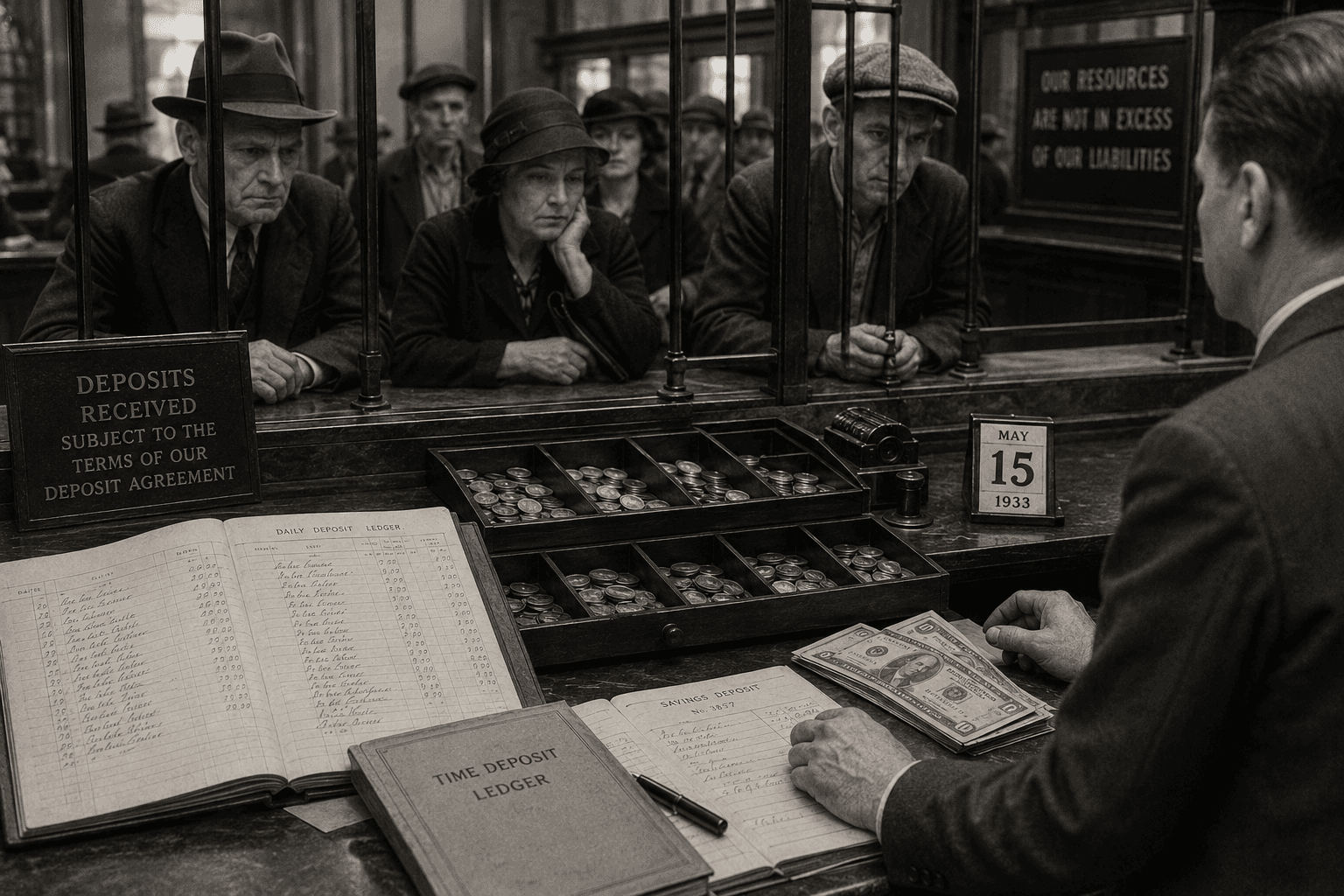
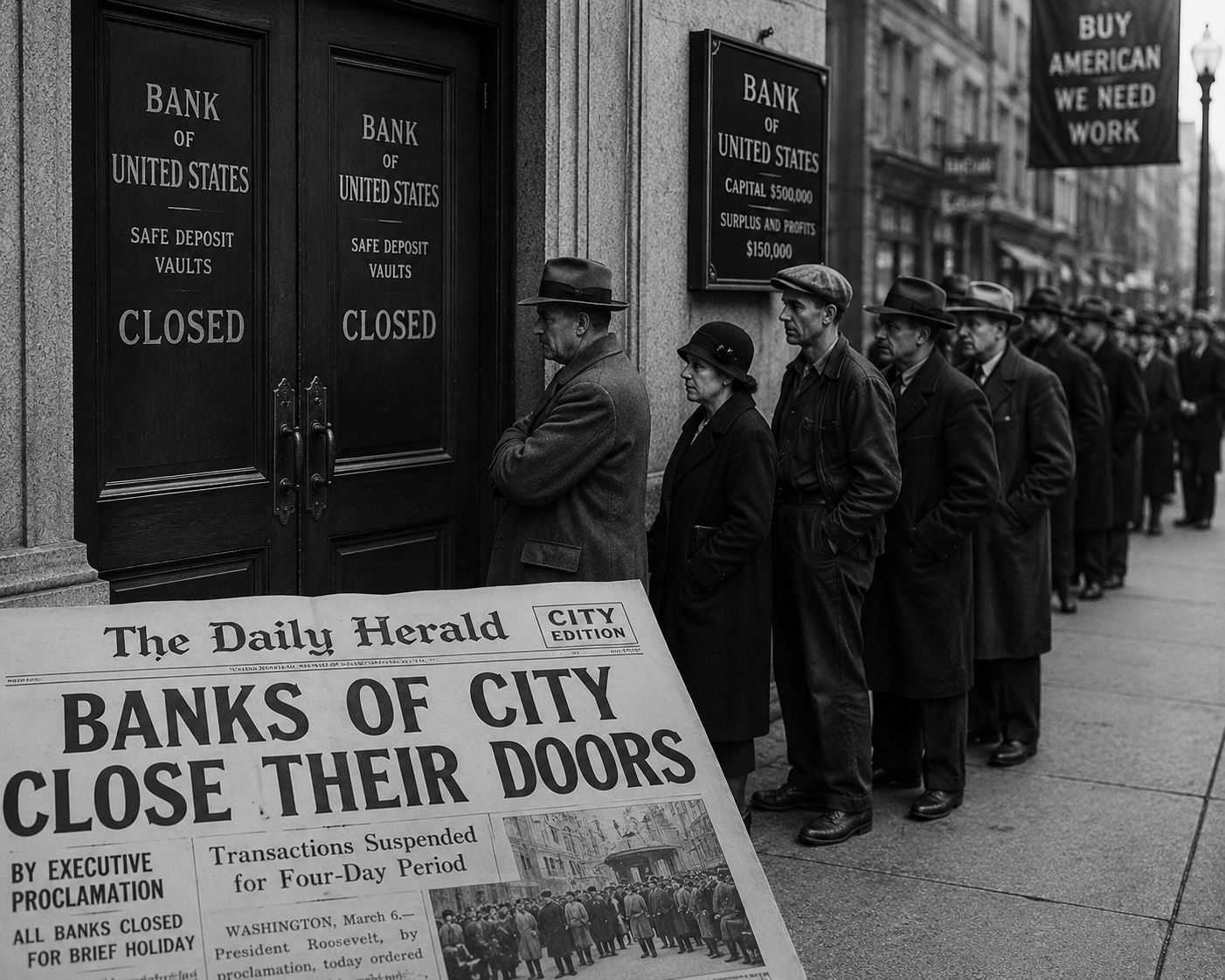
The banking crisis made the wealth shock personal. A stock market crash hurts investors, but a bank failure hurts ordinary depositors. The Federal Reserve History account of the Great Depression points to the banking panics that began in 1930 and ended with the banking holiday of 1933. The FDIC’s own historical timeline records about 4,000 bank suspensions during 1933, with 3,800 by 16 March, and notes that the number of U.S. commercial banks had fallen to just over 14,000, about half the 1920 level.
This changed the political meaning of savings. Before the Depression, depositors bore the risk of choosing a weak bank. After the Depression, that assumption became unacceptable. Deposits were the circulatory system of ordinary wealth. If depositors could lose everything because their bank failed, then household wealth rested on a foundation too weak for a modern economy.
Banking Reform Turned Deposits Into Protected Wealth
The clearest permanent change came through banking reform. The Banking Act of 1933, often associated with Glass-Steagall, separated commercial banking from investment banking and created the Federal Deposit Insurance Corporation. Federal Reserve History describes the Act as one of the most widely debated legislative initiatives of the period and notes that it created the FDIC among other reforms.
That changed global wealth in two ways. First, it made ordinary deposits politically protected. Wealth held in a bank account was no longer treated purely as a private risk between customer and institution. It became a matter of public confidence. Second, it changed the business model of banking. Banks were no longer just private profit-seeking intermediaries; they became institutions whose failure could threaten the public economy.
Deposit insurance changed behaviour
FDIC insurance went into effect on 1 January 1934. The FDIC records that 12,551 commercial banks with around $11 billion of insured deposits gained coverage on the first day. This did not make banking risk disappear, but it changed the psychology of depositor behaviour. A credible backstop reduces the incentive for a panic withdrawal when rumours spread.
That is a foundational wealth lesson. Wealth is not only the assets people hold. It is also their belief that they can access those assets when needed. A protected bank deposit is a different kind of wealth from an uninsured deposit held in a fragile bank during a panic.
The Gold Standard Lost Its Authority Over Wealth
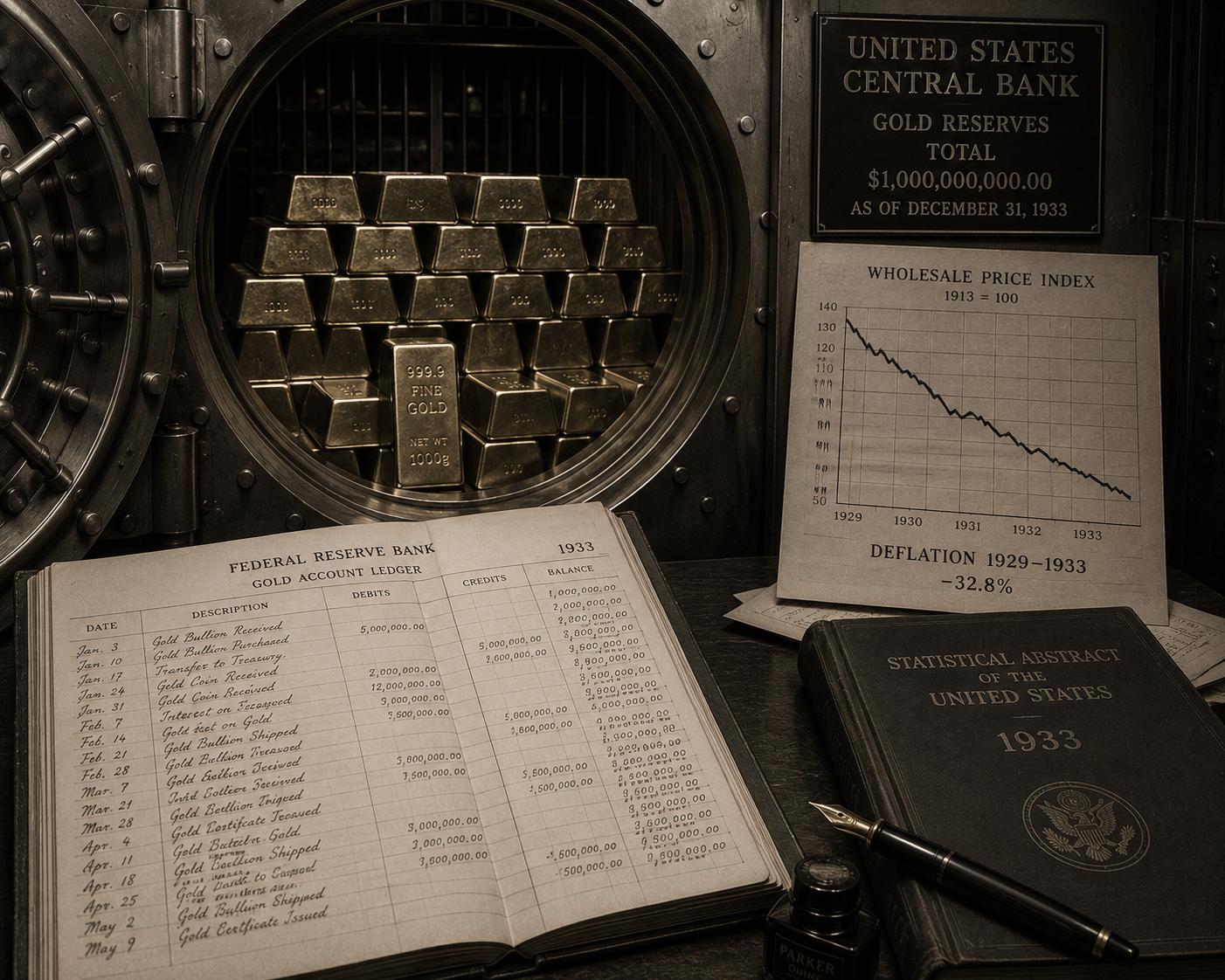
The Depression also changed the monetary basis of wealth. The interwar gold standard was meant to impose discipline and preserve confidence. In practice, it helped transmit deflationary pressure across economies. Countries that tried to defend gold convertibility often tightened policy when they needed relief, deepening the contraction.
Ben Bernanke’s NBER work on the Great Depression and the gold standard summarises the central lesson clearly: countries that left the gold standard recovered from the Depression more quickly than countries that remained on gold, and no country showed significant economic recovery while remaining on the gold standard. That is one of the most important monetary lessons of the twentieth century.
Money became a policy instrument, not just a metal claim
This changed how governments thought about money. A currency could no longer be judged only by its link to gold. It had to be judged by whether the monetary system supported employment, credit and domestic recovery. That did not mean discipline was irrelevant. It meant rigid discipline could become destructive when the economy needed flexibility.
For global wealth, the implication was enormous. Wealth became tied to monetary sovereignty and central-bank capacity. A country that could adjust monetary conditions could recover faster than a country trapped inside a rigid external constraint. The Depression, therefore, helped move the world towards the modern idea that central banks must manage liquidity, crisis response and financial stability, not merely defend a fixed parity.
Global Trade Collapse Repriced International Wealth
The Depression was not just an American event. Britannica describes it as a worldwide downturn beginning in 1929 and lasting until about 1939, the longest and most severe depression experienced by the industrialised Western world. The U.S. Office of the Historian notes that world trade declined by around 66% between 1929 and 1934 during the protectionist spiral associated with interwar tariff policy.
That collapse changed global wealth because trade is a transmission mechanism for prosperity. Exporters lose foreign customers. Importers lose access to goods. Shipping, insurance, warehousing and finance are all contracts. Countries dependent on commodity exports suffer falling prices and worsening public finances. What begins as a domestic crisis becomes a global income shock.
The Smoot-Hawley Tariff became the warning label for protectionism
The Smoot-Hawley Tariff Act of 1930 did not cause the Depression by itself, but it became the emblem of a failed policy response. At a moment when demand was already weakening, higher trade barriers encouraged retaliation and reduced the flow of goods. The result was a smaller world economy with fewer routes for recovery.
This is why the Depression permanently changed trade policy. After the 1930s, major economies increasingly saw trade cooperation as part of wealth protection. The point was not that free trade solved every problem. The point was that competitive closure could make a crisis worse by shrinking the market available to everyone.
The State Became a Permanent Actor in Wealth Protection
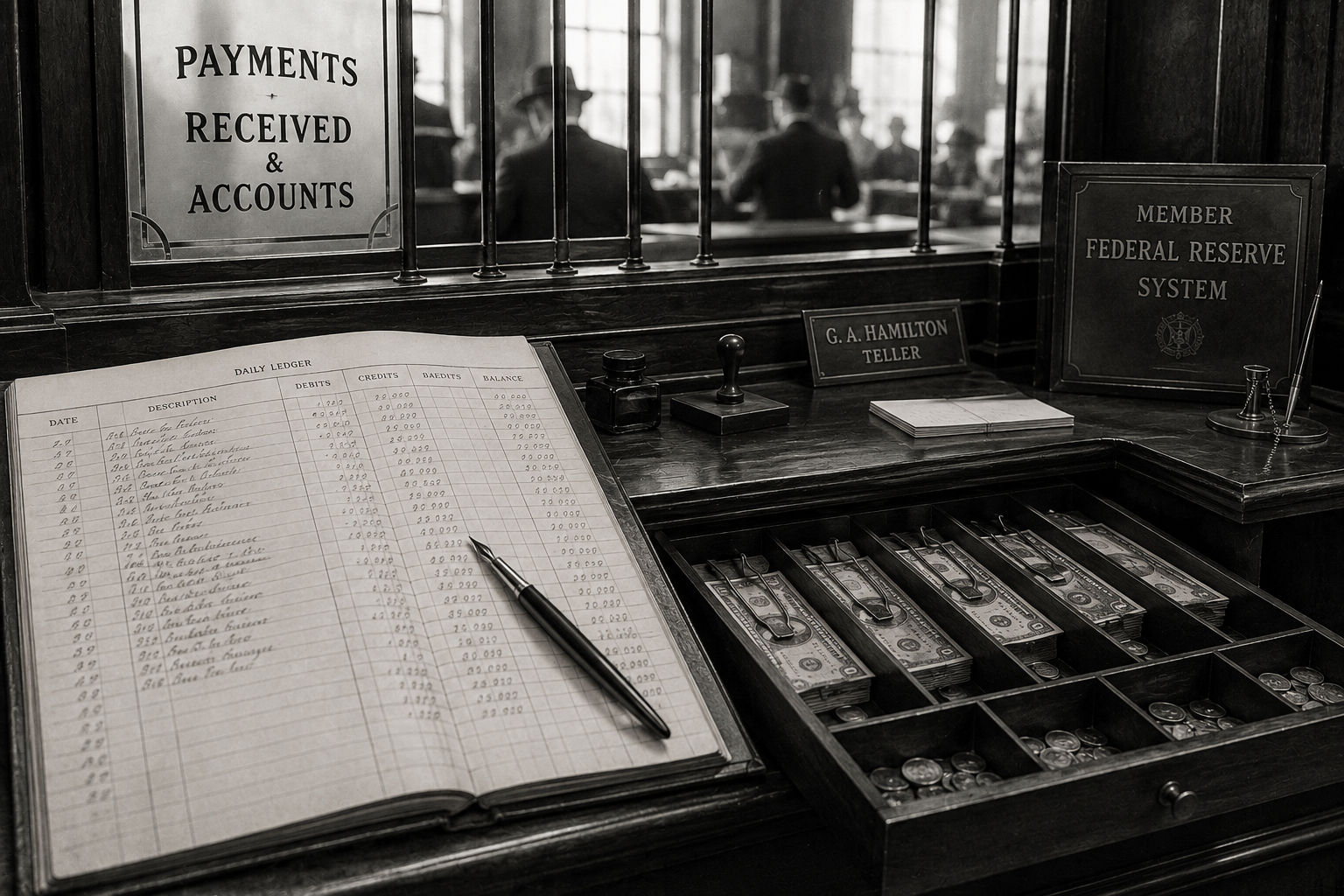
Before the Depression, many governments had limited tools and limited political permission to intervene in financial markets, household income and economic demand. After the Depression, that changed. The New Deal did not create every modern institution, but it accelerated a new settlement: the state would be expected to stabilise banks, regulate securities markets, support labour income and provide some protection against old age and unemployment.
Market disclosure became part of investor protection
The Securities Act of 1933 and the Securities Exchange Act of 1934 transformed the rules around public markets. Investor.gov explains that Congress passed the Securities Act of 1933 in the peak year of the Depression and passed the 1934 Act the following year, creating the Securities and Exchange Commission. The core ideas were simple: investors needed material information, and markets needed rules against manipulation and abuse.
This matters because wealth formation depends on trust. A market can attract capital when investors believe the game is not rigged. The Depression made clear that public markets were too important to be left to weak disclosure, informal norms and speculative excess.
Social insurance changed household wealth
The Social Security Act of 1935 extended the wealth transformation from banks and markets to households. The National Archives records that the Act established old-age benefits for workers, benefits for victims of industrial accidents, unemployment insurance, and aid for dependent mothers and children, people who were blind, and people with disabilities. This did not eliminate poverty, but it changed the social contract.
Household wealth now includes more than private savings. It included claims on public insurance systems. That shift is one reason the Depression changed wealth forever: it made economic security a mainstream policy objective.
Global Wealth Moved From Empire Logic to Institutional Logic
The title of this article is not only about money lost. It is about how wealth was reorganised. Before the Depression, global wealth still carried an old logic: imperial preference, commodity control, gold reserves, creditor power and private banking networks. After the Depression, durable wealth increasingly depended on institutions: insured banks, credible central banks, securities regulation, social insurance, trade agreements and international monetary cooperation.
The Depression exposed that concentrated wealth could be fragile when the underlying system was brittle. A nation could have gold, banks, factories and trade routes, yet still collapse if credit froze, demand disappeared and political confidence broke. The lesson was that wealth without stabilising institutions is vulnerable.
Bretton Woods was downstream of the Depression
The post-war monetary order did not emerge from the Great Depression alone, but the memory of the 1930s shaped it. Policymakers had seen what happened when countries pursued deflation, tariffs and competitive national responses. Bretton Woods was, in part, an attempt to prevent a return to that world by giving states a framework for exchange-rate management, reconstruction finance and international economic cooperation.
That is the deeper historical link. The Depression changed global wealth by making economic coordination part of national self-interest. Wealth could not be protected by isolation alone.
What This Means Today
Financial stability is a form of wealth
Modern investors often think of wealth as property, shares, cash and pensions. The Depression reminds us that the infrastructure around those assets matters just as much. Deposit insurance, central-bank liquidity, securities disclosure, payment systems and credible regulation are not background details. They are part of the wealth itself because they determine whether assets remain accessible and trusted during stress.
Hard-money discipline can become a trap
The gold-standard lesson still matters. Monetary discipline can restrain excess, but inflexible discipline during a collapsing economy can turn recession into depression. The question for modern economies is not whether money should be sound. It is whether the monetary regime can absorb shocks without forcing unnecessary deflation and unemployment.
Trade policy can protect or destroy wealth
The Depression also shows why trade policy must be treated as macroeconomic policy. Tariffs can look like sector protection, but in a stressed global economy they can reduce demand, trigger retaliation and destroy export income. Wealth is created in networks. When those networks are deliberately broken, the damage rarely stays local.
Household security is macroeconomic infrastructure
Finally, the Depression changed the way governments viewed household security. Unemployment insurance, pensions and deposit protection are often discussed as social policy, but they are also macroeconomic stabilisers. They support confidence, spending and political legitimacy when private markets fail.
Frequently Asked Questions
How did the Great Depression change global wealth?
The Great Depression changed global wealth by destroying confidence in banks, markets, gold-backed money and protectionist trade policy. It led to new institutions such as deposit insurance, securities regulation, expanded social insurance and a stronger role for central banks and governments in stabilising economies.
Why was the Great Depression so damaging to household wealth?
It damaged household wealth because people lost jobs, wages, savings and access to credit at the same time. Bank failures meant many depositors could lose money even if they had avoided the stock market.
Did the Great Depression end the gold standard?
It did not end gold-based monetary thinking instantly, but it destroyed the credibility of the interwar gold standard. Countries that left gold earlier generally recovered faster, making monetary flexibility a central lesson of the crisis.
How did banking reform protect wealth after the Depression?
Banking reform protected wealth by creating deposit insurance and separating ordinary commercial banking from higher-risk investment banking activities. FDIC insurance made depositors less likely to panic and reduced the risk of bank runs.
Why did world trade collapse during the Great Depression?
World trade collapsed because demand fell, credit tightened and governments raised trade barriers. The U.S. Office of the Historian estimates that world trade declined by around 66% between 1929 and 1934.
What was the biggest long-term legacy of the Great Depression?
The biggest long-term legacy was the creation of a more interventionist financial state. Governments became expected to protect deposits, regulate markets, manage monetary conditions and provide basic forms of household economic security.
Does the Great Depression still matter for modern investors?
Yes. It shows that wealth depends on systems, not assets alone. A portfolio is stronger when the surrounding banking, monetary, regulatory and social institutions are credible enough to withstand a crisis.