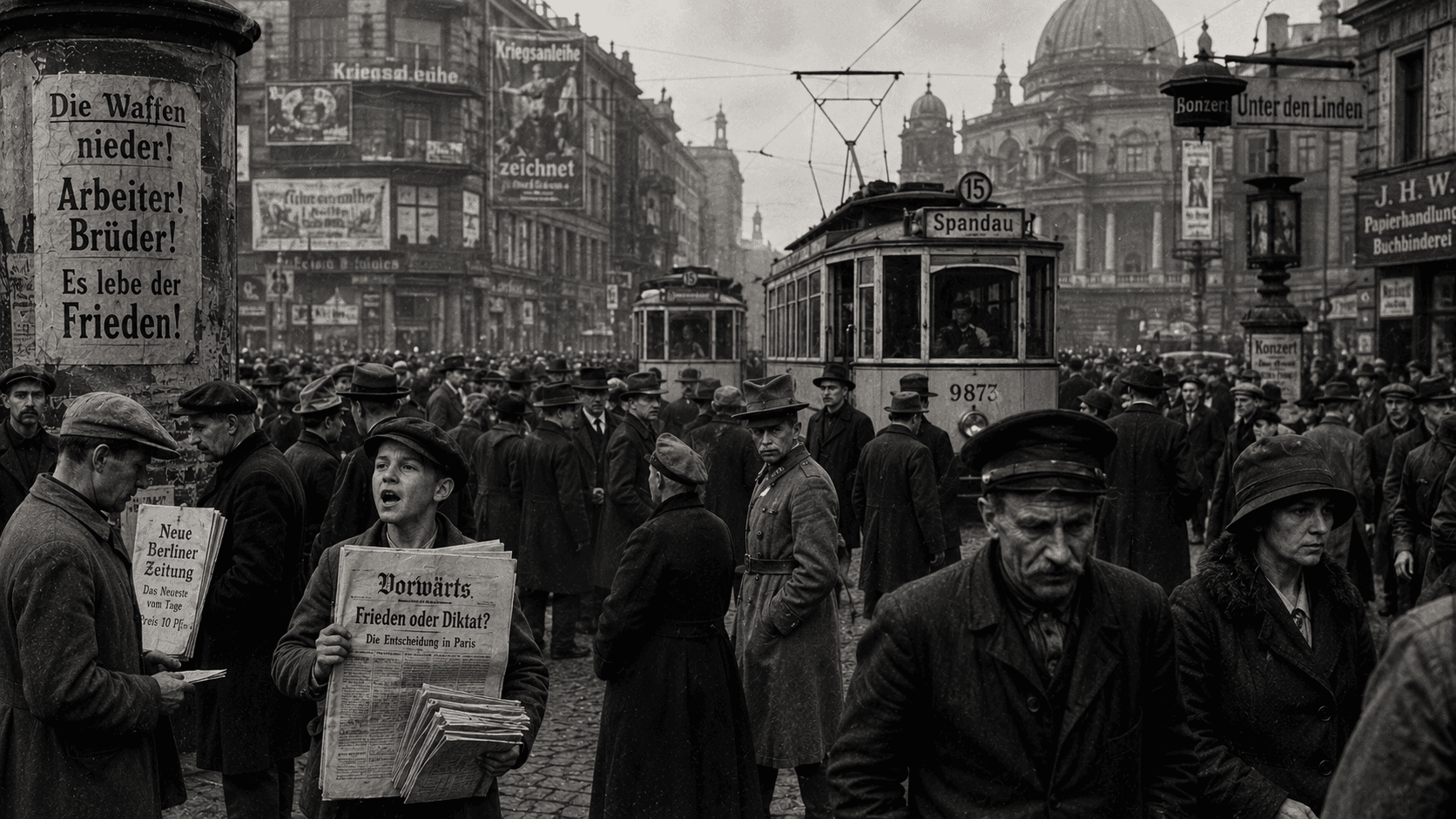
The rise and fall of Weimar Germany began with a republic trying to build legitimacy on the ruins of defeat. In 1919, Germany was not only rebuilding a state; it was rebuilding trust in money, government, law and national identity. That made Weimar one of the most important financial stories of the twentieth century. It created a modern democracy, stabilised after one of history’s most famous hyperinflations, and briefly looked as if it had escaped disaster. Then the world credit system snapped. Foreign loans disappeared, unemployment surged, parliament fractured, emergency powers replaced the coalition government, and political extremism filled the space left by economic despair.
To understand Weimar, we need to follow the money. The republic rose when credit, currency reform and diplomacy gave it time. It fell when those supports failed together.
Quick Answer: Why Did Weimar Germany Rise and Fall?
Weimar Germany rose because the post-war republic managed, for a time, to convert defeat into a working democratic state. It inherited the Treaty of Versailles, reparations, social unrest and a damaged economy, but the constitution created universal suffrage, proportional representation and a parliamentary system. After the 1923 hyperinflation, the Rentenmark, the Dawes Plan and foreign loans gave Germany a short period of monetary stability and renewed investment.
It fell because that recovery depended on unstable foundations. The republic never fully escaped the political stigma of defeat, the economy relied heavily on external credit, and the constitution allowed presidential emergency powers under Article 48. When the Great Depression hit after 1929, Germany suffered mass unemployment, banking stress and collapsing confidence. The centre weakened, extremist parties grew, and by 1933, the republic’s legal machinery had been used to install a government that destroyed it from within.
The Republic Born in Defeat
The cost of losing a war
Weimar began in the wrong emotional register. The monarchy had collapsed, soldiers were returning from a lost war, and the new republic had to sign the peace settlement that many Germans experienced as humiliation. The Treaty of Versailles did not simply impose territorial and military restrictions. It also turned the new democracy into a face of defeat. That mattered because financial systems depend on legitimacy. Taxes, bonds, currency and public spending all require a basic belief that the state can endure. Weimar had to ask citizens to trust a government that many blamed before it had properly governed before.
A constitution with ambition and danger
The Weimar Constitution was ambitious. It offered democratic representation, universal suffrage and a modern rights framework. But its electoral system produced fragmented parliaments, and Article 48 gave the president emergency decree powers in national crises. In calm conditions, this could look like a safety valve. In a collapsing economy, it became a route around parliamentary consent. The weakness was not democracy itself. The weakness was a system that could lose a majority government and continue by executive command.
The First Fall: Inflation, Ruhr and the Broken Mark
Why the mark collapsed
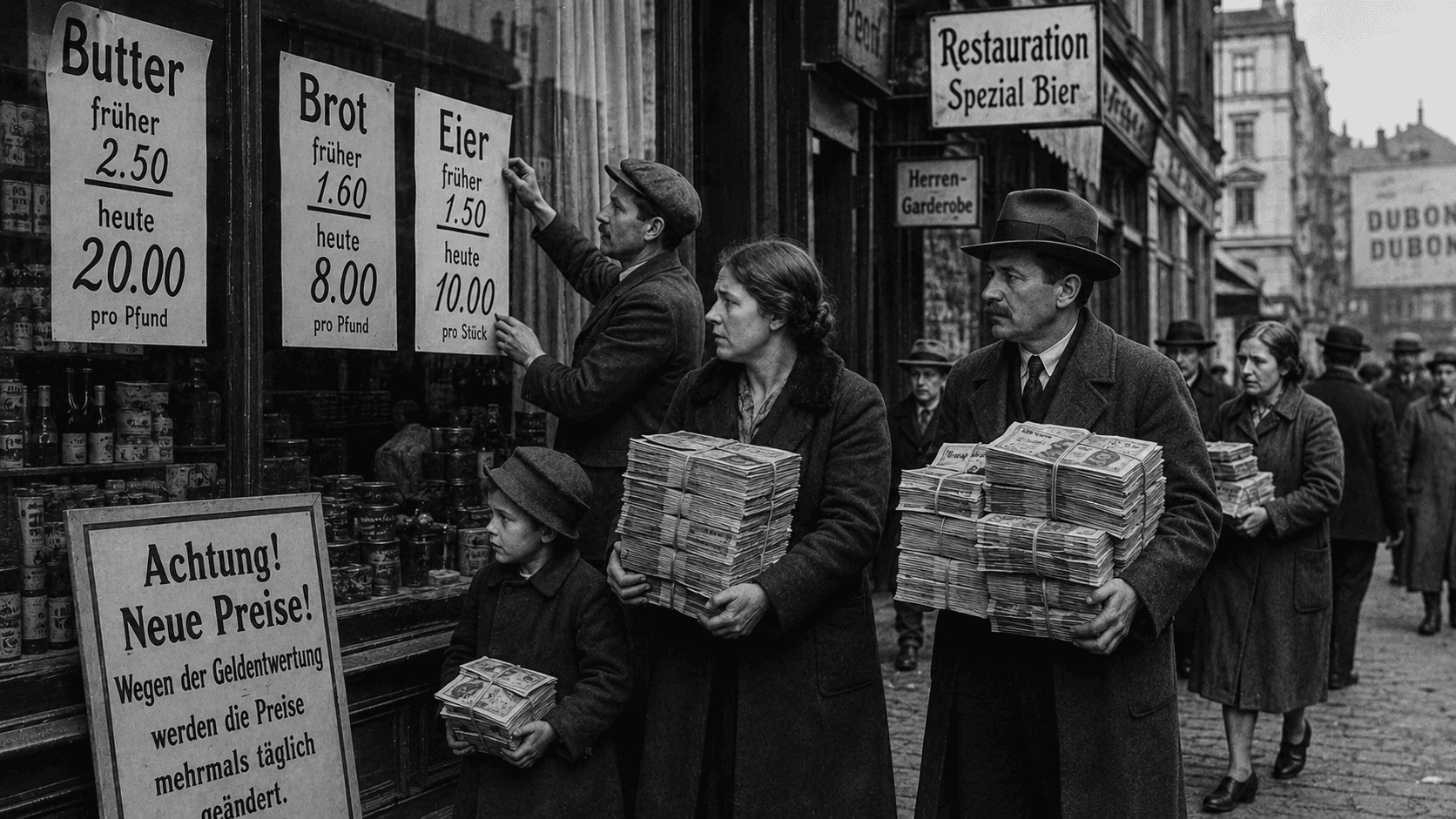
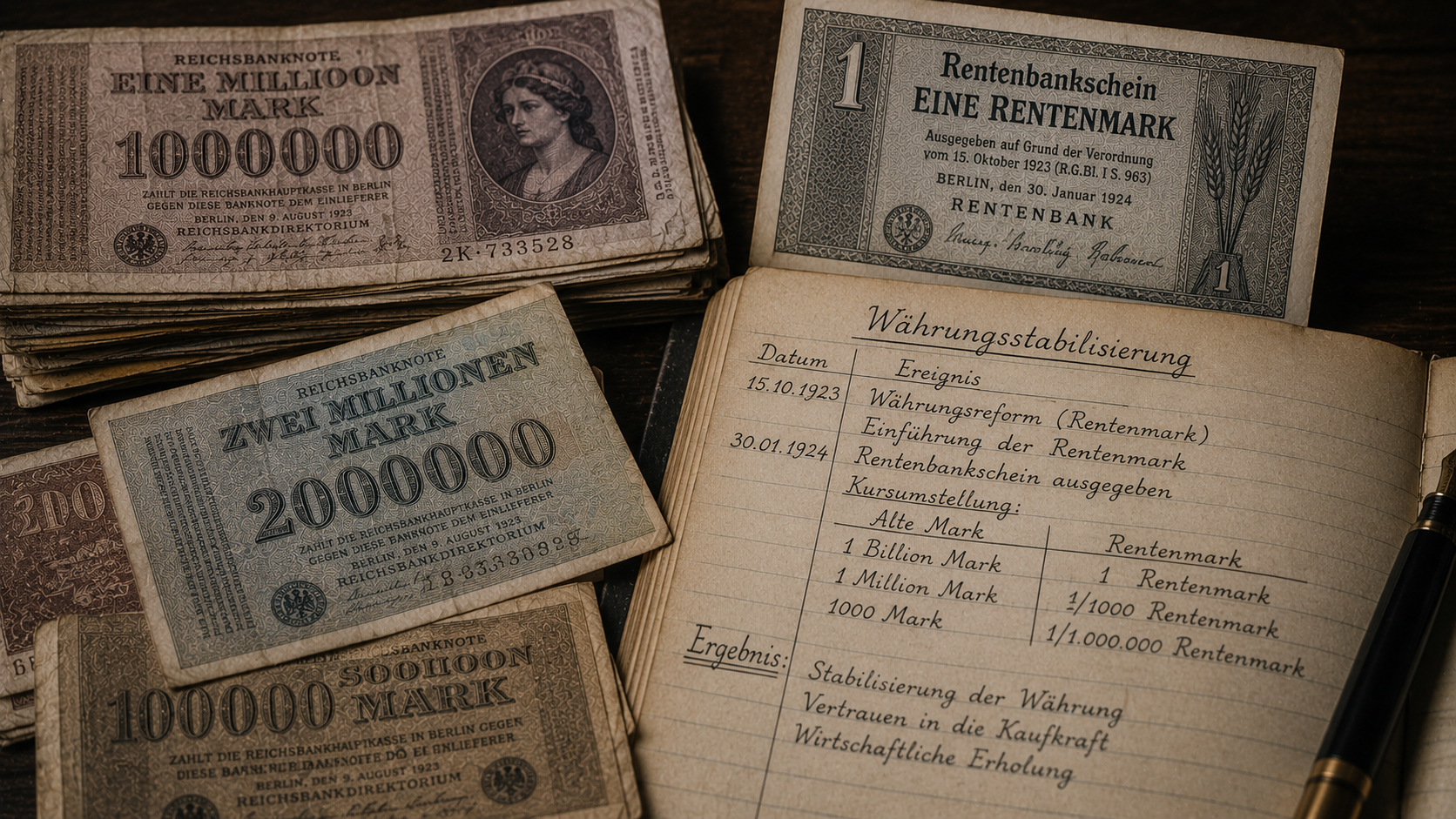
The hyperinflation of 1923 was not a freak accident. Germany carried war debts, reparations pressures and a state budget under strain. When French and Belgian troops occupied the Ruhr in January 1923 to enforce reparations, the German government supported passive resistance by paying workers not to cooperate. Output fell, tax receipts weakened, and the state financed the gap by issuing money. The mark fell faster than ordinary life could adjust.
The human story behind the numbers
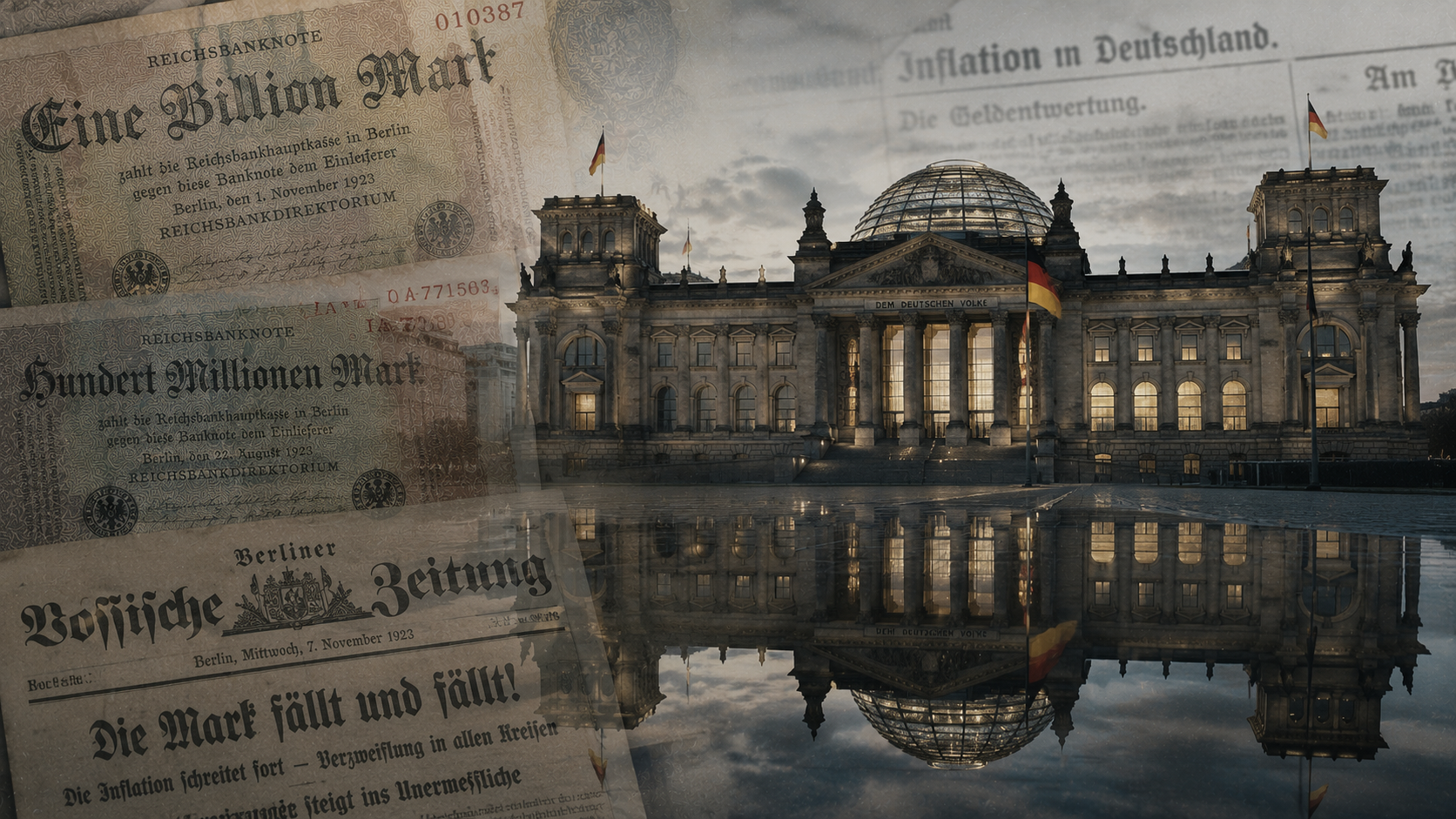
The most memorable images from 1923 are not abstract charts. They are people carrying banknotes in baskets, wages paid daily, and families rushing to spend cash before prices changed again. The Bundesbank describes a world in which wages could be paid daily, and traders constantly raised prices because the mark was losing value so quickly. That is the critical lesson: hyperinflation is not just high inflation. It is the collapse of the time value of money. A wage paid in the morning can be worth less by evening.
The Recovery That Looked Like Salvation
The Rentenmark and the return of monetary order
Stabilisation came when the state stopped pretending that paper alone could restore trust. In November 1923, Germany introduced the Rentenmark in strictly limited quantities. Britannica records that it was backed by a mortgage on industrial and agricultural resources, while Hjalmar Schacht’s role at the Reichsbank became central to the stabilisation effort. The financial message was simple: the new money would be limited, anchored and politically defended.
The Dawes Plan and borrowed prosperity
The Dawes Plan of 1924 restructured reparations payments and opened the door to foreign lending, especially from the United States. This helped Germany refinance, rebuild and re-enter international capital markets. But it also created a vulnerability that is easy to miss. The recovery was real, yet it was funded by a credit chain that ran through foreign lenders. Weimar did not fully own its stability. It leased it from global capital markets.
The Golden Twenties Were Not as Solid as They Looked
Culture boomed while balance sheets stayed fragile
Berlin in the mid-to-late 1920s produced art, architecture, film, publishing and nightlife that still define the period in popular memory. But cultural confidence should not be confused with balance-sheet strength. Government finance, local authority spending, banks and industry all depended on flows of credit that could reverse. A society can look modern, creative and alive while its financial structure remains brittle.
Why confidence mattered more than appearances
A stable currency gave households and businesses the confidence to plan again. Foreign lending allowed infrastructure, factories and public services to expand. But a credit-led boom is exposed to the psychology of lenders. When investors believe tomorrow will look like yesterday, money is abundant. When they fear repayment risk, liquidity disappears. Weimar’s recovery depended on the willingness of outsiders to keep rolling over the system.
The Great Depression Exposed the Structure
The global credit chain snapped
The Wall Street crash and the Great Depression did not simply make Germany poorer. They attacked the mechanism that had kept Weimar stable. Foreign credits dried up, and existing loans were called in. Britannica describes late-1920s German prosperity as precarious because it depended heavily on foreign credits; when these dried up, Germany was pushed into a severe slump. This is why Weimar belongs in financial history, not only political history. The external financing model turned a global shock into a domestic political emergency.
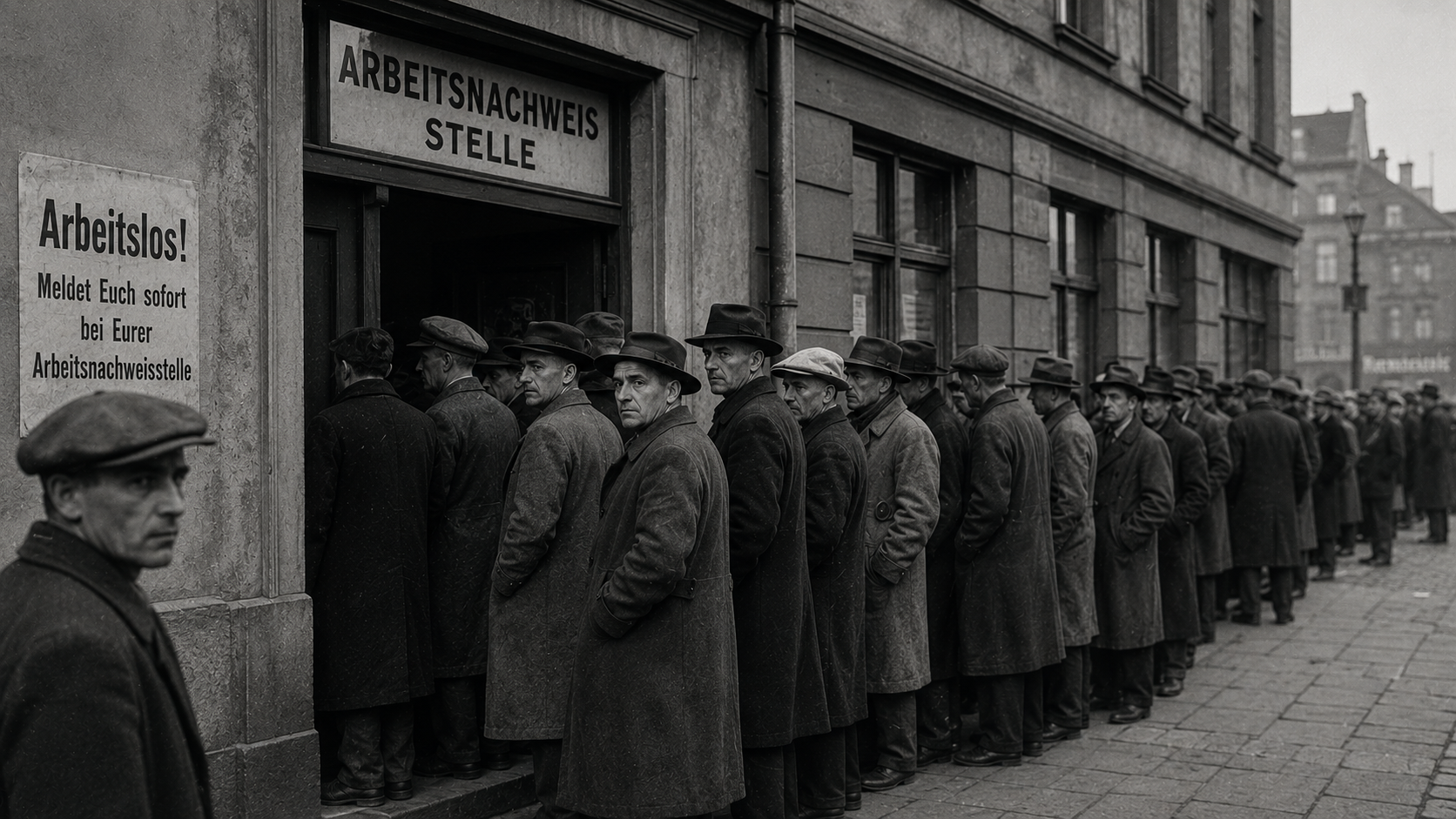
Unemployment became the republic’s breaking point
Mass unemployment transformed economic pain into political anger. German History in Documents and Images records that unemployment reached around 5.6 million in 1932. Britannica’s Germany coverage puts the winter 1932 number at roughly six million and notes that German industry was operating at no more than 50% capacity while foreign trade fell sharply between 1929 and 1932. These numbers matter because democracy is hardest to defend when millions feel abandoned by ordinary institutions.
Emergency Government Replaced Parliamentary Confidence
Article 48 moved from the safety valve to the operating system
Article 48 was meant to let the president respond to emergencies. Under the pressure of the Depression, it became a normal method of government. Brüning’s cabinet increasingly relied on presidential decrees after losing reliable parliamentary support. Once a republic begins governing by exception, the exception becomes a precedent. The legal form remains democratic, but the habit of democratic bargaining weakens.
Austerity without consent
Brüning pursued deflationary policies, spending restraint and wage pressure in an attempt to preserve confidence, meet obligations and maintain Germany’s international position. The political cost was severe. Households experienced the state as an enforcer of hardship, not a shield against collapse. Whether one views Brüning as constrained by international finance or mistaken in domestic policy, the political effect was the same: the centre took ownership of pain while radicals sold certainty.
How Extremism Converted Economic Collapse into Power
From fringe movement to mass party
Before the Depression, the Nazi Party was a marginal force in national electoral terms. The Bundestag’s account of the Weimar elections records the NSDAP rising from 2.6% in 1928 to 18.3% in 1930. By July 1932, the party won 230 seats and became the largest party in the Reichstag. That surge was not simply propaganda working in a vacuum. It was propaganda amplified by unemployment, distrust, deflation, rural distress and the memory of hyperinflation.
Why fear moved in two directions
Weimar’s crisis pulled voters toward both the radical right and the radical left. For business owners, farmers and parts of the lower middle class, communism could look like a threat to property. For unemployed workers and disillusioned labourers, capitalism and parliamentary compromise could look bankrupt. The political centre was squeezed between two stories of rescue: one national, authoritarian and racial; the other revolutionary and class-based.
The Final Fall: A Republic Handed Over by Its Own Elites
The chancellorship as a political gamble
By late 1932, German conservative elites believed they could use Hitler’s mass support while containing him inside a cabinet dominated by traditional conservatives. This was one of the fatal miscalculations of modern history. The republic did not fall in a single street battle. It fell through appointments, decrees, bargaining and elite confidence that an anti-democratic movement could be managed once inside government.
Legal form, anti-democratic substance
Hitler became the Chancellor on 30 January 1933. The appointment followed constitutional procedure, but the political substance was the end of the republic. This is the dark lesson of Weimar: institutions can be hollowed out while still appearing legal. A system can preserve forms of office while abandoning the habits, norms and restraints that make democracy function.
The Financial Lesson of Weimar Germany
Money, legitimacy and democracy are linked
Weimar shows that currency collapse can outlive the moment of inflation. The 1923 hyperinflation ended, but its memory remained. It damaged the social contract between the state, saver and citizen. Later, when the Depression arrived, many Germans already had experience of institutions failing to protect ordinary wealth. That made radical explanations more emotionally plausible.
External credit can buy time, not sovereignty
The Dawes Plan and foreign loans helped stabilise Germany, but they also made recovery dependent on international capital. A state that relies heavily on external financing can grow quickly in good conditions and unravel quickly when creditors retreat. The lesson is not that foreign capital is bad. The lesson is that borrowed stability must be used to build internal resilience before the cycle turns.
What This Means Today
Economic shocks become political shocks when institutions lose trust
The rise and fall of Weimar Germany is a warning about sequencing. Economic damage does not automatically destroy a democracy, and inflation alone does not automatically produce dictatorship. The danger grows when repeated shocks convince citizens that ordinary institutions cannot protect them. Weimar suffered military defeat, reparations, hyperinflation, credit dependency, depression and unemployment within one generation. Each crisis weakened the credibility of the next official solution.
Stability must be built deeper than asset prices and credit flows
Modern economies can look healthy when borrowing is cheap and capital is plentiful. Weimar shows why that can be deceptive. A recovery based on external credit can create real growth, but it can also hide dependency. The deeper question is whether the state has fiscal capacity, trusted institutions, productive investment and a political system able to make decisions under stress.
Legal systems need democratic norms, not only procedures
Weimar did not fall because it lacked laws. It fell partly because legal mechanisms were used after democratic confidence had eroded. Emergency powers, decree government and elite manipulation turned constitutional form into a vehicle for anti-constitutional power. The lesson for today is precise: institutions need rules, but they also need political actors willing to defend the spirit of those rules when a crisis makes shortcuts attractive.
Frequently Asked Questions
What caused the rise and fall of Weimar Germany?
Weimar rose because Germany built a democratic republic after the First World War and stabilised after hyperinflation through currency reform, reparations restructuring and foreign lending. It fell because those foundations were fragile: the economy depended on external credit, unemployment exploded after 1929, parliament fractured, and emergency powers replaced normal democratic government.
Was Weimar Germany doomed from the beginning?
No. Weimar faced severe structural problems, but it also achieved real stabilisation in the mid-1920s. Its collapse came from the interaction of inherited war burdens, monetary trauma, foreign-credit dependence, the Great Depression and political choices made by elites in the early 1930s.
Why was hyperinflation so damaging to Weimar Germany?
Hyperinflation destroyed savings, wages, pensions and trust in the state. Even after the Rentenmark stabilised the currency, the memory of 1923 remained politically powerful because it convinced many citizens that the republic could not protect their wealth.
What role did the Dawes Plan play in Weimar Germany?
The Dawes Plan helped stabilise Germany by restructuring reparations and enabling foreign lending. It supported recovery in the 1920s, but it also left Germany exposed when international credit dried up after the Wall Street crash.
How did the Great Depression affect Weimar Germany?
The Great Depression hit Germany especially hard because the recovery had depended on foreign loans. As credit disappeared, unemployment surged into the millions, industry contracted, and extremist parties gained support from voters who had lost faith in parliamentary solutions.
Why did Article 48 matter in the fall of Weimar Germany?
Article 48 allowed the president to issue emergency decrees in crises. During the Depression, this power became a routine way to govern without stable parliamentary majorities, weakening democratic habits and making authoritarian politics easier to normalise.
What is the main lesson of Weimar Germany today?
The central lesson is that money, legitimacy and political stability are connected. A democracy can survive economic pain, but repeated financial shocks become dangerous when citizens stop believing that lawful institutions can protect income, savings and social order.